The Alaska Plate Problem: How One License Plate Broke Our Road-Trip Scoring
The first time an Alaska plate showed up at a Sunday farm-show parking lot in Minnesota, it felt like finding a twenty-dollar bill on the sidewalk. Everyone crowded around. The math agreed: Alaska’s capital sits nearly two thousand miles from Saint Paul as the crow flies, and only three-quarters of a million people live there. By the rules of the founding spreadsheet, that plate was worth more than every other state combined.
It felt great for exactly one afternoon. Then the rest of the season turned into a formality, because the person with the Alaska plate had already won, and everybody else was collecting decorative hubcaps. This is the story of how we fixed the math without killing the magic.
The arithmetic of rarity
Every plate game eventually answers one question: what makes a plate special? Our founding answer multiplied two honest intuitions. First, distance — a plate seen far from its home capital means somebody drove a long way, or shipped a long way, and sightings across an ocean of miles are genuinely rare. Second, population — a small state simply has fewer cars in the world to run into. A Wyoming sedan is rarer in the wild than a California one for the same reason a lynx is rarer than a deer.
So the classic formula took the distance between the capital you are standing in and the capital the plate belongs to, and divided it by the plate’s home-state population, scaled so the numbers feel like points:
points = capital-to-capital miles × 100,000 ÷ home-state population, floored at one.
Rounded to whole numbers and stamped onto the game forever, that formula is the one that lived in the founding spreadsheet — and it is still one menu choice away, for anyone who likes their road trips brutal.
The golden snitch problem
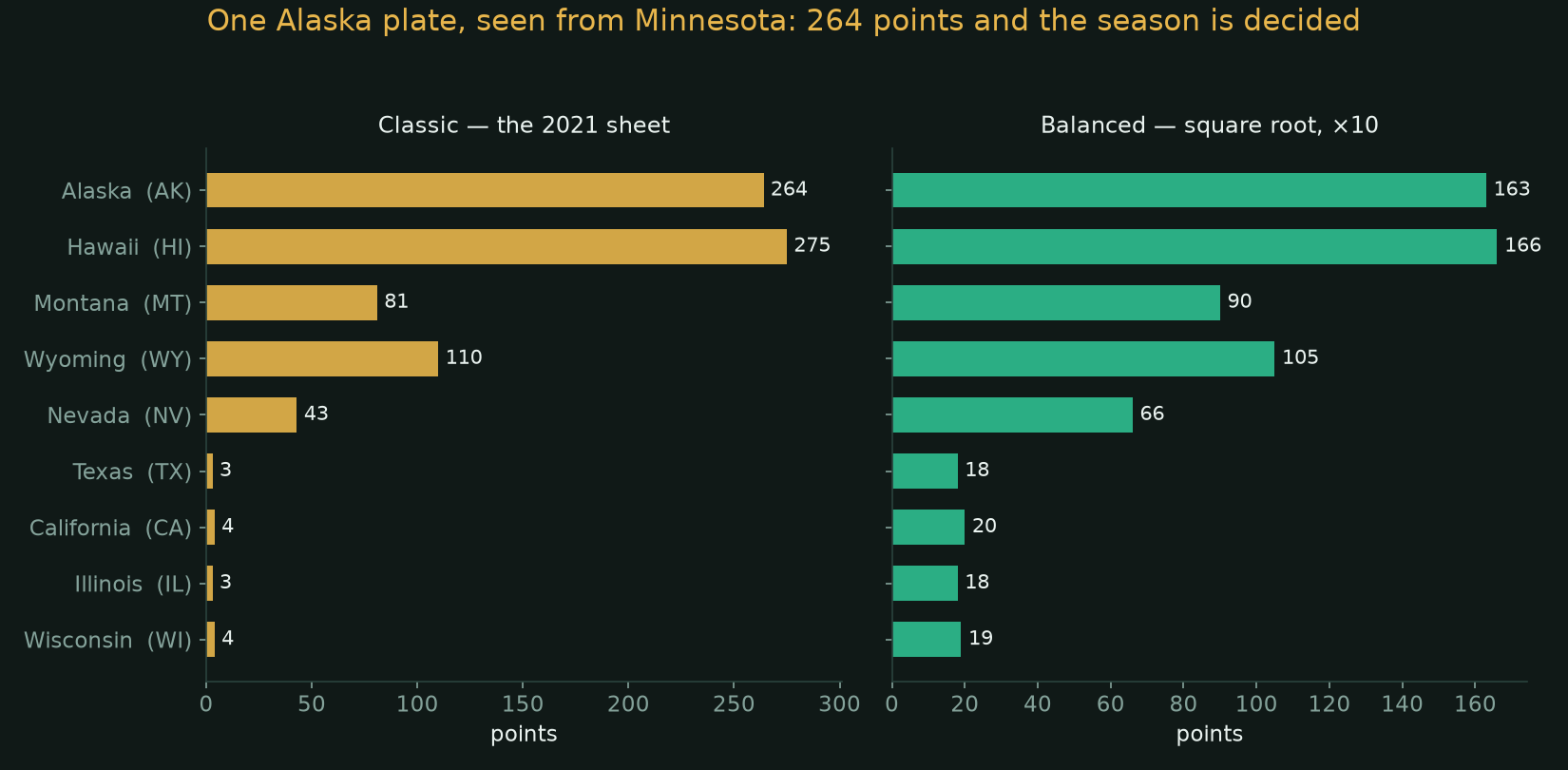
Look at the left panel above. Seen from Minnesota, an Alaska plate is worth 264 points and Hawaii edges it out at 275 — Honolulu is far away and there are barely any Hawaiians. A Montana plate is a respectable 81. A California plate, from the most populous state in the union, is worth a stately four points. And that 264 is the whole problem in one number.
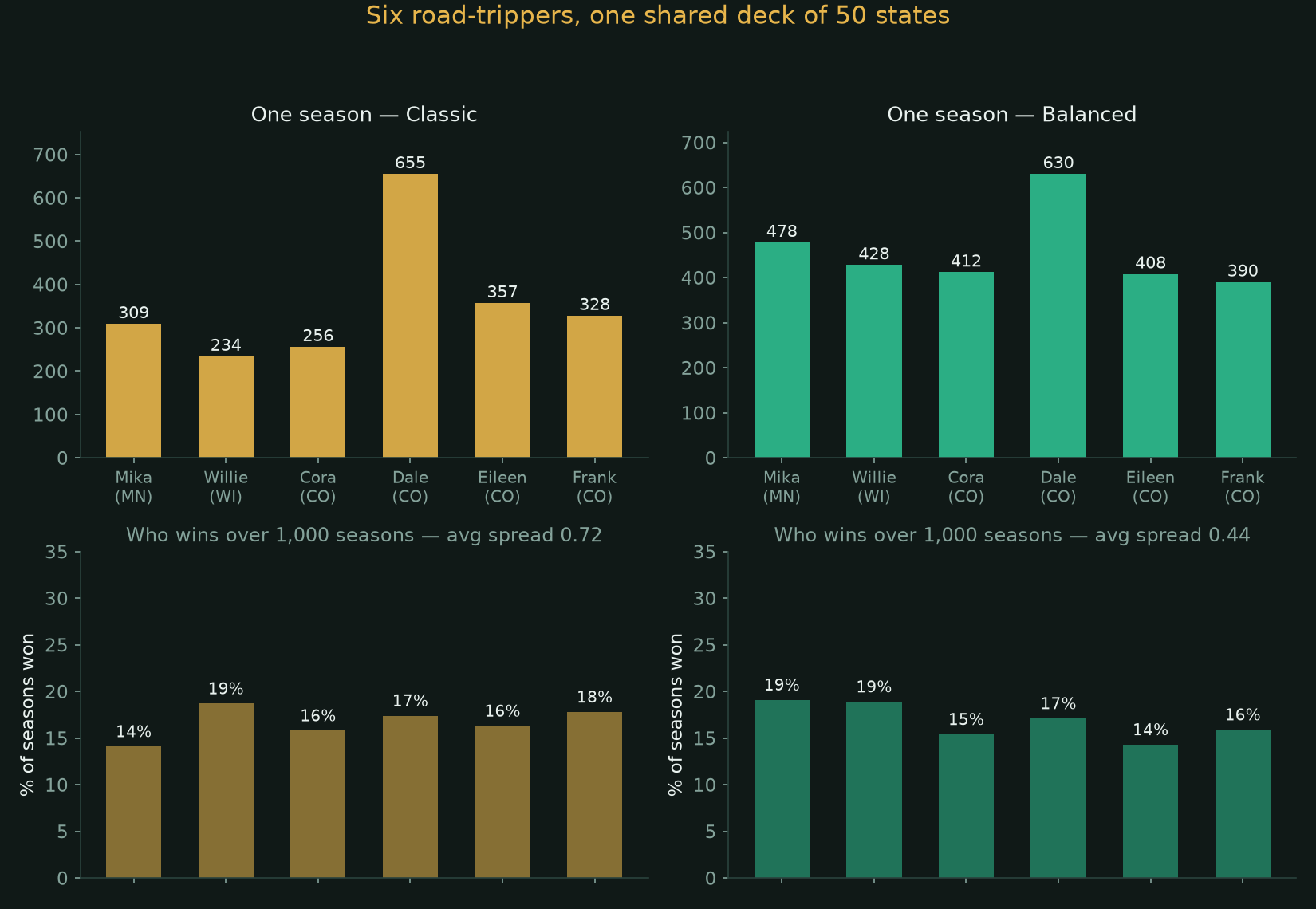
We simulated it properly: six players — one in Minnesota, one in Wisconsin, four in Colorado — handed the fifty states out at random, every player keeping whatever plates landed in their lap. Under the classic curve the winner finished with 655 points while last place scraped 234. The Alaska and Hawaii draws alone, dealt to the same lucky Coloradan, decided the season before most players had found their fifth state. The average gap between the leader and the tail sat at 0.72 — meaning the loser of a typical season banked barely a quarter of what the winner did. A game whose winner is crowned by Saturday stops being a game by Wednesday.
The square root saves it
The fix was one character of arithmetic: take the square root of the raw points before rounding. Compress, don’t flatten. And because a scoreboard is more fun with four-digit drama than with decimals, we multiplied the result by ten — the same curve, given room to breathe. On that curve, Alaska from Minnesota is 163 — the biggest headline catch on the board, with Hawaii edging it in both universes as usual — but no single snitch is remotely safe anymore: a patient pair of Wyoming-class finds out-boards it by Thursday, Wyoming 105, Montana 90, Nevada 66. Seasons come down to the last parking lot instead of the first.
points = 10 × √(capital-to-capital miles × 100,000 ÷ home-state population), rounded to a whole number and floored at ten.
The average spread drops from 0.72 to 0.44, and over a thousand simulated seasons every player wins roughly fourteen to nineteen percent of them. We tried the neighbors on the curve family and they each failed differently: a gentler exponent of 0.7 still left Alaska worth 50, king of the hill; a logarithmic curve compressed everything until an Alaska plate scored 24 and a Vermont plate 22 — a gap you would not cross a parking lot for, which murders the entire point of chasing Alaska in the first place. The square root is the needle: the snitch stays golden, it just stops being the only metal in the vault.
Alaska, to the person who actually lives there
There is one more wrinkle that any rarity formula has to survive. If you live in Alaska, an Alaska plate is not a trophy. It is a commute. Both curves handle this without a single special-case rule, because the score is built from distance and distance collapses honestly: from Juneau, Juneau is zero miles away, so the local Alaska plate scores the floor value — one classic point, ten balanced ones. Over a thousand seasons of Alaska’s gold on a Minnesota board, and a flat ten when an Alaskan snaps one at home. The golden snitch only exists away from home — geography takes care of the rest.
Our third experiment normalized every score by the average distance from the observer’s own state, so every player scores their own neighborhood on a level curve. It is elegant, and we retired it to the lab notebook in the same week: by construction it rewards living far from everything, and our Wisconsin player quietly won 27.5 percent of a thousand simulated seasons on pure geography. A scoring system that hands out a head start for your zip code isn’t balanced, it’s just biased in a new direction.
The rule lives inside the game
None of this math retroactively touches a single point anyone ever earned. Each game picks its curve at creation — classic, with the 2021 spreadsheet’s winner-take-all drama, or balanced — and that choice is frozen into a versioned rule set the game carries for life. Leaderboards are made of the rules that were actually in force, which is the difference between a scoreboard and a rumor.
What the season taught us
- Multiplicative intuitions overshoot. Rare times far turns into absurd once a real population ratio rides along. Compress before you ship.
- The biggest catch should be the biggest night, not the only night. A hundred sixty-three points is the most any single balanced plate can hand you — and a patient Wyoming 105 plus Montana 90 out-boards it by Thursday.
- Distance collapses for free. Local plates are ordinary under any distance-based curve — no exemption rules, no state-of-the-resident special cases.
- Version your rules. Immutable scoring turns every future formula change from a rewrite of history into a new game.
The founding spreadsheet still lives in a drawer, Alaska cell glowing gold at 264. We kept it honest by keeping it on the menu — for the purists, for the archaeologists, and for the next time someone wants to feel what it was like when one plate was worth the whole road trip.