Physical AI Moves Into the Robot’s Joint
For most of the last two years, the AI hardware story has been about the data center: the accelerator, the memory beside it, and the optical and electrical links shoveling data between them. This week at electronica 2026 in Munich, three announcements pointed the other way, toward the machines that actually move. The story is not a new model. It is where the intelligence lives: pushed from a rack in a cold aisle down into the elbow, the wrist, and the joint of a robot.
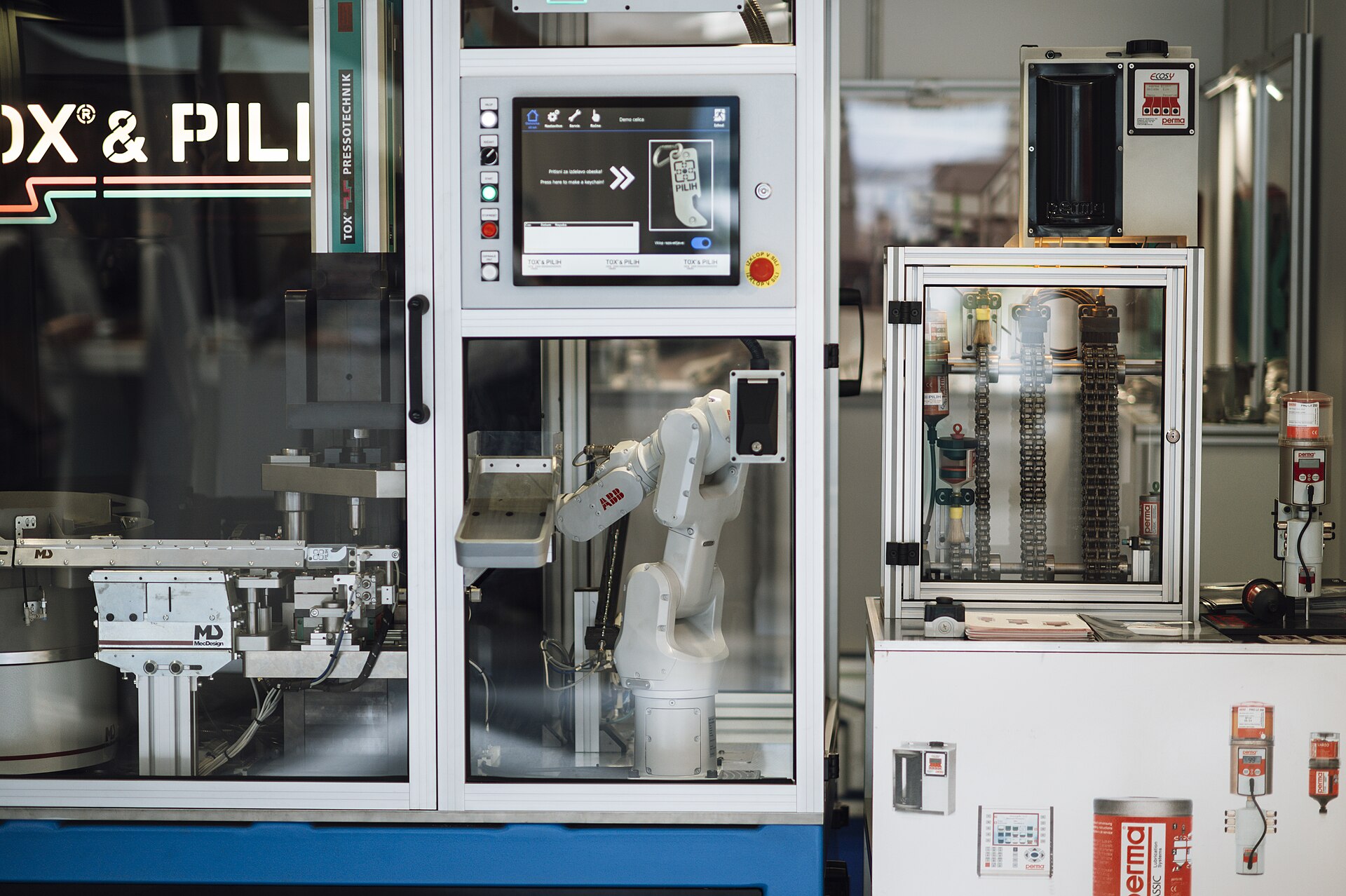
The clearest signal came from MIPS, the RISC-V unit inside GlobalFoundries. On November 9 it updated its Actus reference platform, a single-chip joint controller built for the part of a robot that is hardest to fit anything into. A robot’s end effector and its joints have almost no room, little heat capacity, and a tight power budget, yet today that region often carries several separate chips. Actus wants to collapse that into one part on GlobalFoundries’ energy-efficient FDX FD-SOI process, pairing two MIPS Atlas M8500 real-time RISC-V microcontrollers with a 512-bit vector unit for sensor fusion and predictive-maintenance models. Its trigonometry acceleration is claimed to run field-oriented motor control more than 16 times faster than standard software libraries, and each node carries three-port Time-Sensitive Networking plus a hardware security module with post-quantum cryptography. MIPS gave no silicon date and no price, and Green Hills Software is extending a safety-certified stack to it, so this is a platform being announced, not a part you can order today.
Why the joint, not the head
There is a real reason the action has moved to the extremities. The frontier model running a robot’s high-level reasoning is expensive, slow, and, for a machine that must not hesitate, often wrong on timescales. A joint does not care about your 100,000-token context window; it cares about a deterministic control loop that closes in a few milliseconds, every time, without a network round-trip to the cloud. That is a hardware problem, and it is exactly why the two big European chip groups that supply power semiconductors, sensors, and microcontrollers have started talking about the same thing.
At the same Munich gathering, the CEOs of Infineon, STMicroelectronics, and NXP argued that Europe is “well positioned to compete with the US and Asia in robotics and physical AI,” leaning on the continent’s long strengths in automotive and industrial silicon. The phrase they reached for, “physical AI,” names the shift: software that does not only recommend, but acts on a body. STMicroelectronics even said it had agreed to put humanoid robots from Italy’s Oversonic into its own factories, with the first installed at a semiconductor plant in Malta. Most of that is still at the trial stage, and the honest framing is a roadmap, not a proven deployment.
The other two pieces of the puzzle
Two companion announcements at electronica rounded out the picture. Teradyne launched Omnyx Edge, which takes its data-center board-testing platform and points it at the boards inside cars, robots, and factory equipment, sorting them into intelligence, sensing, and motion categories and using AI to predict its own maintenance. And Kopin, the small Massachusetts company, said it will expand its Westborough site to make MicroLED displays for soldier and pilot headgear, alongside a technology it calls Neural I/O that would send data between AI processors as light. The display business is the near-term revenue; the interconnect is the long shot, and it puts a regional maker in a race with far larger optical players.
What it means for a person who runs robots, not data centers
Strip the marketing and a consistent theme emerges: the bottleneck for physical AI is not a shortage of clever models, it is a shortage of cheap, deterministic, on-device compute that can live inside a machine and still be trusted when a mistake has no undo. NXP’s CEO put it bluntly at the conference: “There’s no undo for a broken bone if you make a wrong decision.” That sentence is the whole thesis. The chips getting attention this week are small, power-aware, safety-obsessed, and RISC-V open. If the data-center race is about how fast a model thinks, the physical-AI race is about how fast and how safely a body can move, and that race is being decided in the joint.
A couple of caveats keep this grounded. Actus is a platform preview with no shipping silicon date, the European chipmakers’ confidence is a strategic position rather than a shipment, and Kopin’s MicroLED capacity adds at most 80 jobs over five years. This is the early, trial-heavy stage of a category, and the right move is to watch the silicon dates and the safety certifications, not to count on any of it being in a robot you would buy this year. But the direction of the money and the engineering is unmistakable: the intelligence is moving out of the rack and into the machine.