Fairer Games, Better Tests, Quieter Maintenance

The most useful progress this week came from making things less dramatic: a fairer road-trip game, a more honest image test, and a better way to keep practical knowledge from getting stranded in one place. None of those improvements needs a grand launch. Each makes the next ordinary day a little easier.
At Oddbyte, the week ending November 20 was a reminder that finishing a feature and finishing a project are different achievements. A small, well-tested milestone deserves credit without pretending that everything around it is settled.
A rare plate should make your day, not end the game
PlateMania continued to grow from a scoring idea into a usable application. Merged work carried the game through account flows, photo-led interaction and successive refinements. The interesting design problem, though, was not how many buttons could fit on a screen. It was how to keep a lucky discovery exciting without making everyone else’s season pointless.
Distance and rarity sound like sensible ingredients for a license-plate game. Multiply them too enthusiastically, and a single exceptional find can dominate the scoreboard. A square-root curve compresses those extremes while leaving the uncommon plates worth chasing. Scaling the result keeps the numbers satisfying rather than reducing the game to a handful of decimals.
The important companion idea is that a game keeps the rules it started with. Improving tomorrow’s scoring should not quietly rewrite yesterday’s result. That is a useful principle well beyond games: when a rule affects people’s expectations, changing it should be an explicit choice, not a surprise hidden inside an update.
Real photographs are tougher than a tidy demo
The image-recognition work supplied a second, less glamorous lesson. A retained set of labeled photographs let the experiment separate finding a plate from identifying its state. Those are different jobs, and combining them into one flattering accuracy number would hide where the system actually struggles.
The detector produced crops for 49 of 57 labeled photographs. Some of the remainder contained no visible plate; others were genuine misses. Among the 48 cases used for classification, a second-pass reranking step improved correct first choices from 31 to 34.
That is a modest improvement, not a victory lap. It is useful precisely because it can be reproduced. The next experiment can target the misses instead of trying to outshine an anecdote. A test set becomes more valuable when its awkward examples stay in view.
Knowledge has to travel
Another strand of work concerned the instructions that make recurring technical jobs repeatable. Useful procedures had accumulated unevenly, with newer guidance available in one place and older copies elsewhere. Moving generic runbooks into a shared, reviewed catalog made that knowledge easier to discover and maintain.
For AI agents, the distinction between knowing a procedure and being able to execute it matters. A successful document load proves that the instructions are available. It does not prove that every required tool, service connection and practical judgment has been qualified. Treating those as separate milestones makes the remaining work more concrete, not less ambitious.
This is also why a good handoff needs more than “done.” It should say what was exercised, what remained unchanged and where the next person might encounter a missing prerequisite. Clear boundaries are part of a useful result.
Maintenance should be boring on purpose
The week’s infrastructure work reinforced the same theme. Automated maintenance is safest when each mechanism has a defined job rather than overlapping responsibility. Housekeeping should distinguish disposable caches from installed tools, preserved history and valid recovery material. More storage provides breathing room; it does not replace a retention policy.
The best maintenance routines are quiet when things are healthy and specific when they need attention. They should not require a fresh research project every time they run. Nor should a reassuring dashboard stand in for checking that an important notification reached its destination.
Carrying the useful parts forward
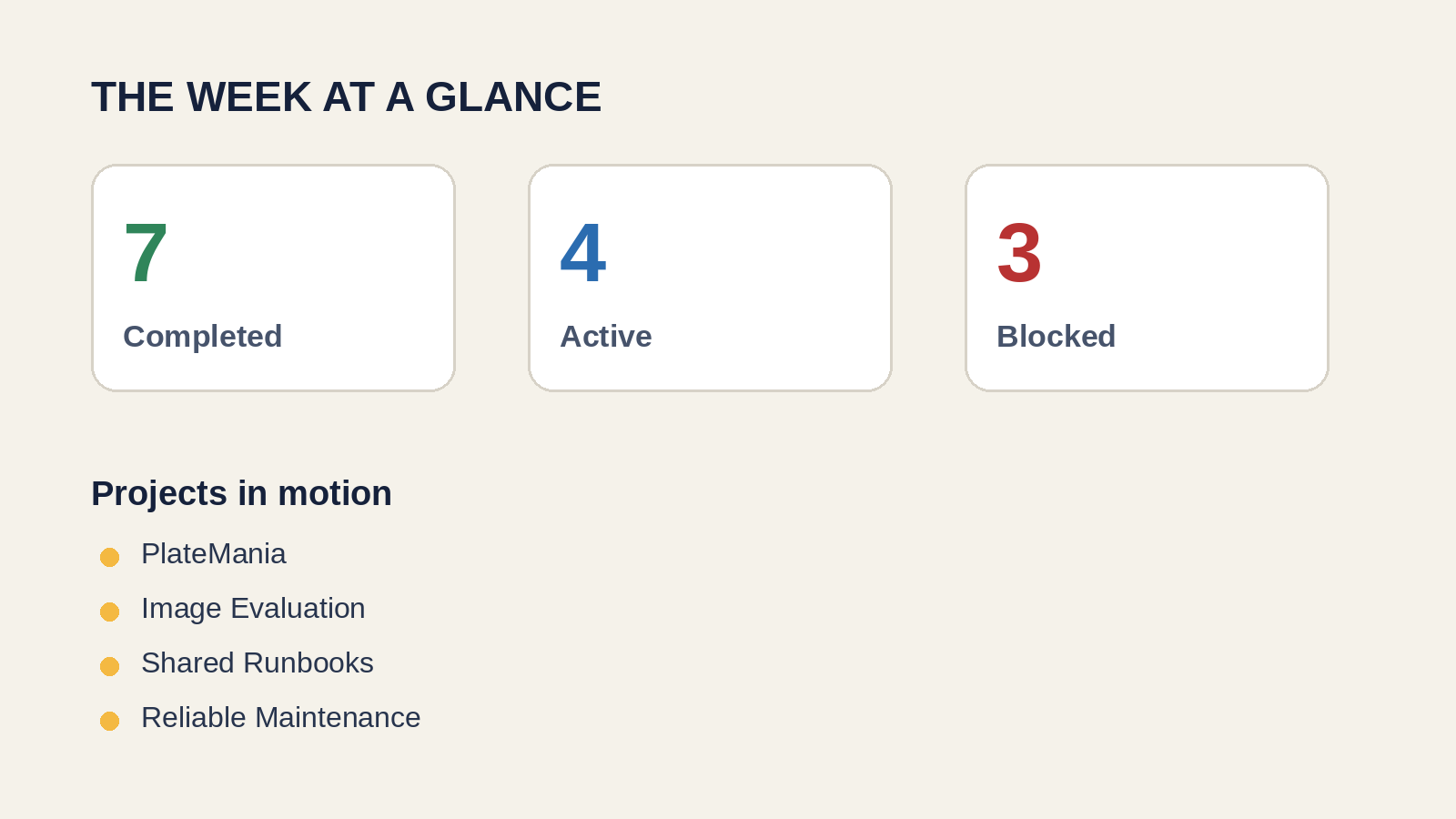
The accompanying summary counts bounded milestones and follow-through work, not a pile of conversations or a claim that every project is finished. Seven work packages reached a completed checkpoint; four remain active, with three follow-through tracks waiting on prerequisites. Those categories can sit inside the same larger project.
Next comes the work that makes these gains durable: improve the difficult photo cases, keep shared procedures current, qualify recovery rather than merely collecting copies, and judge delivery by what actually arrived. The theme is simple enough to fit on a workshop wall: keep the magic in the game, and take it out of the maintenance.