Qwen 3.5 4B was quick, but its code review got stuck in a loop
A real-workflow qualification of oMLX Qwen 3.5 4B: fast bounded work, repetitive repository review, and an 82.8 percent false-or-materially-wrong rate after source adjudication.

A real-workflow qualification of oMLX Qwen 3.5 4B: fast bounded work, repetitive repository review, and an 82.8 percent false-or-materially-wrong rate after source adjudication.
A real-workflow qualification of oMLX Qwen 3.8 27B 8-bit: strong bounded work, useful code-review leads, and a costly false-positive problem.

I expected this test to end with a speed chart. It ended with a subtraction problem. The subject was Qwen 3.8 27B on a 64 GB M5 Max, served two ways: Ollama 0.34.4 and oMLX 0.7.0rc1. I wanted two answers that are easy to blur together. First, which serving engine handles the closest practical 4-bit…
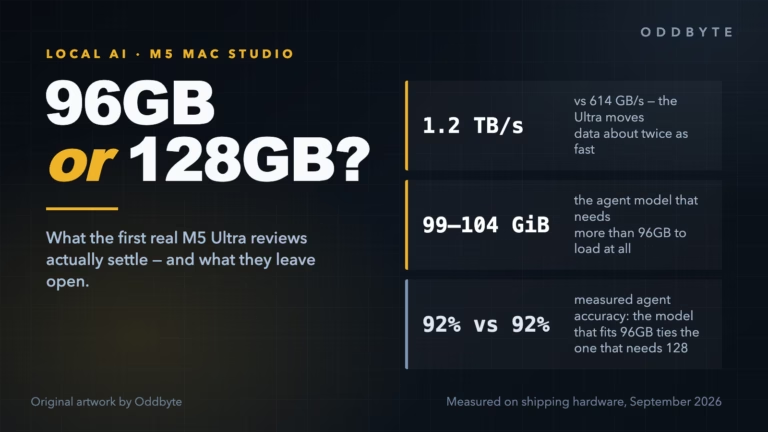
The two Mac Studios are $100 apart. One has twice the bandwidth; the other has 32GB more memory. Measured weight files and the first shipping-hardware reviews show which trade actually matters for a local AI agent.
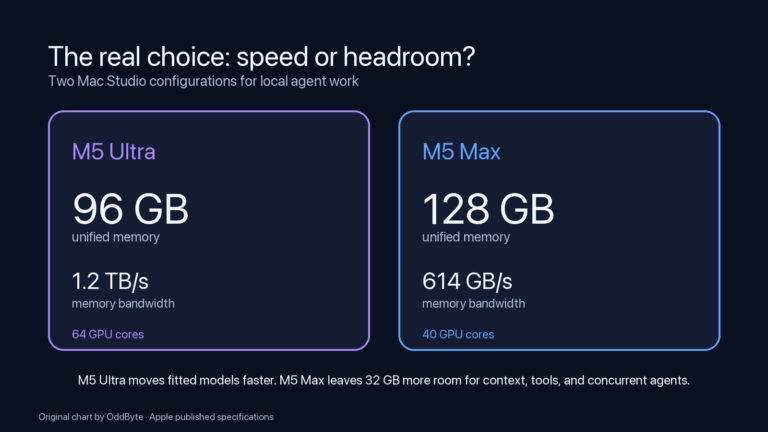
The 96 GB M5 Ultra is faster when a model fits; the 128 GB M5 Max leaves more room for context and concurrent agents. Release-week measurements sharpen the call.

Updated 12-hotel qualification benchmark showing how a bounded Firecrawl fallback changed extraction readiness for Gemma 4 31B and Qwen 3.5 9B.

Updated 24-run ledger including bounded Firecrawl recovery, retained sources, hashes, failures, and final package status.

A 28-route benchmark starting with only a hotel name and full address: models planned searches, selected websites, and faced deterministic retrieval validation.

Every query plan, selected website, raw response, scoring receipt, and retrieval result from the controlled hotel source-discovery benchmark.
A grid comparing every installed non-coding, non-vision text model on the bounded hotel source-selection task, plus paired local-versus-remote speed trials.