
M5 Ultra speed or M5 Max memory? A preliminary local-LLM buying guide
Apple has created an awkward Mac Studio choice for anyone building a serious local AI workstation. The entry M5 Ultra has 96 GB of unified memory and enormous bandwidth. A configured M5 Max can reach 128 GB, but moves data at roughly half the rate. One machine is faster when the model fits; the other leaves more room for larger models, longer conversations, and parallel agents.
Launch week added sharper results, though they do not settle everything: the most detailed M5 Ultra review used an 80-core, 256 GB machine, and nobody has measured the base 64-core, 96 GB configuration. What the first comparisons show is a smaller speed gap than the specifications imply, and a memory ceiling that arrives sooner than the capacity numbers suggest.
The specifications point in opposite directions
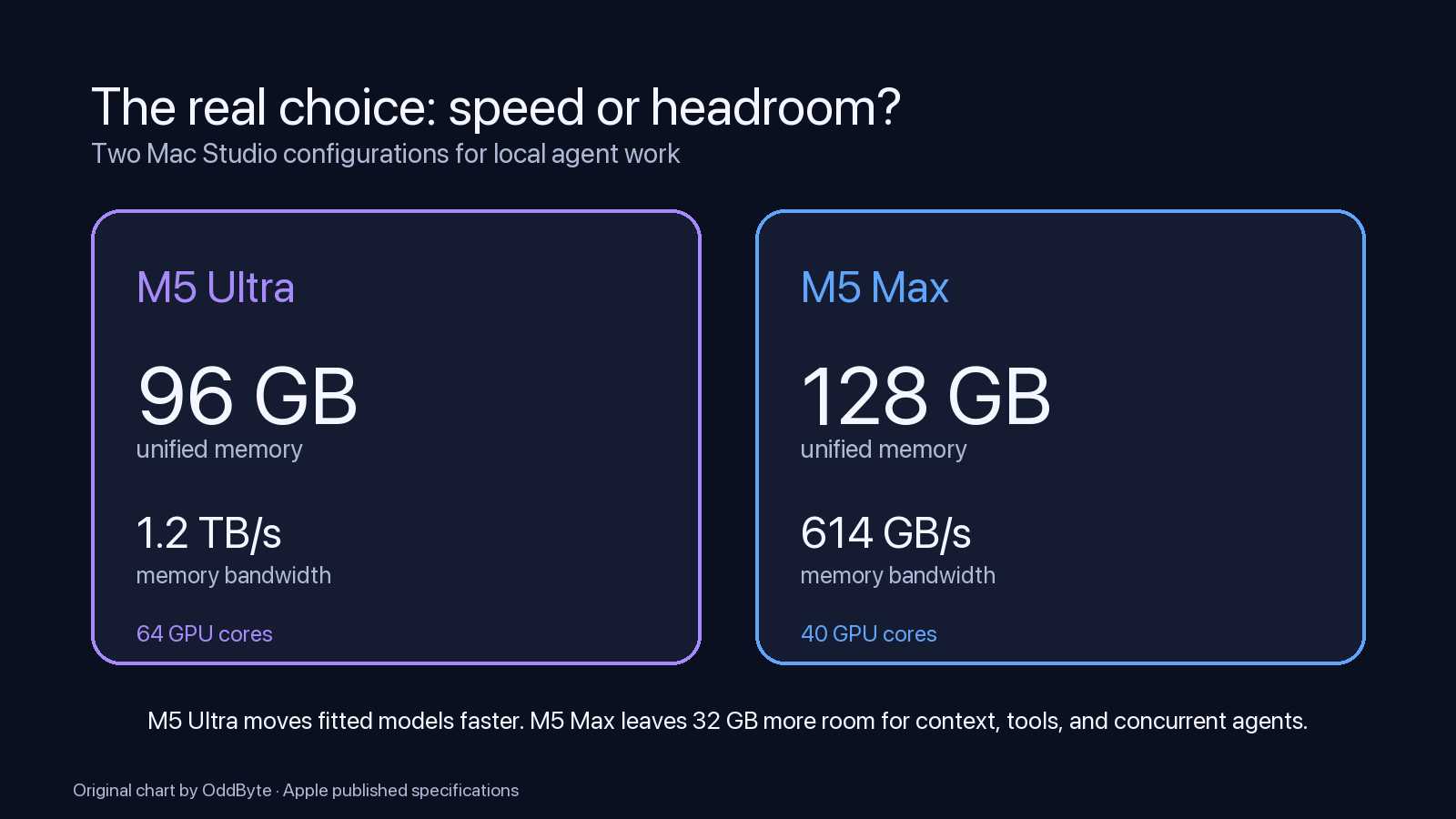
The 96 GB M5 Ultra has a 64-core GPU and 1.2 TB/s of memory bandwidth. The 128 GB M5 Max has a 40-core GPU and 614 GB/s. The Ultra has nearly twice the bandwidth; the Max provides 32 GB more room. Local generation is usually limited by how quickly weights move through memory, so the Ultra should write tokens faster whenever both machines run the same model and quantization, while prompt processing, which leans on compute, should also favor the Ultra's larger GPU.
Capacity is less forgiving. A 100 GB model does not become usable because the chip around 96 GB is faster, and the operating system, inference server, and agent runtime all need memory too. A 70 GB model can fit on paper and still leave too little for a long agent session.
What has actually run on 128 GB
The community oMLX benchmark database already holds useful M5 Max results. These are individual recipes rather than a controlled shootout, but they show the range of practical workloads. A 4-bit GPT-OSS 20B used about 11 GB and generated 137 tokens per second at 4K context, falling to 91 at 32K and 44 at 128K. A 6-bit Llama 3.3 70B used 55.5 GB but managed only 7.2 tokens per second, while a 4-bit 120B-class mixture-of-experts model used 59.5 GB and reached 89.7.
Parameter count alone does not predict speed. Dense models touch most of their weights for every token, while mixture-of-experts models activate a much smaller portion, so a larger model can run faster than a smaller dense one.
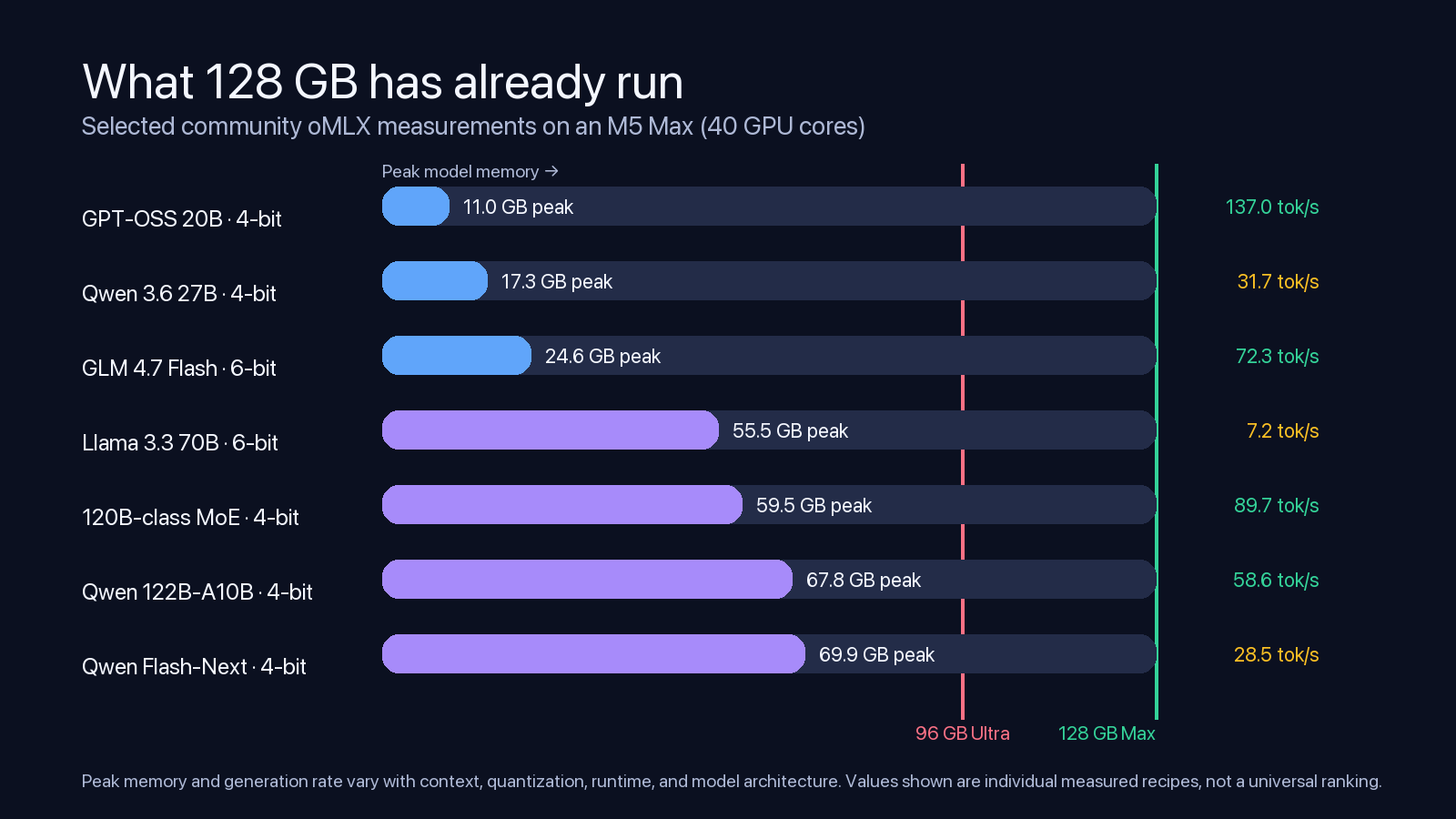
One Qwen Flash-Next recipe used a 69.9 GB active footprint, but total system use peaked at about 100.8 GB. That fits 128 GB and does not fit safely inside 96 GB.
What the M5 Ultra review tells us
MacStories tested an 80-core M5 Ultra with 256 GB using oMLX and concurrent requests. Qwen Flash-Next exceeded 100 tokens per second on short work and sustained roughly 61 to 84 as context grew from 64K to 128K, and still produced 74.7 after a 256K prompt. At 16K context the reviewed Ultra read 2,887 prompt tokens per second, generated at 108, and delivered its first token in 5.6 seconds. Three simultaneous requests reached 81.5 combined output tokens per second.
Those numbers should not be copied onto the 96 GB model. The base Ultra has 64 GPU cores rather than 80 and less than half the memory. It keeps the same 1.2 TB/s bandwidth, so generation from a model that fits may stay close, while prompt processing should lose more ground because prefill leans on GPU compute. That remains a projection until reviewers test the exact configuration.
Which models belong on each machine
Both machines handle 20B-to-35B models at 4-bit or 6-bit quickly, and both run 70B dense models and many 120B-class mixture-of-experts models at 4-bit. On 96 GB those become one-large-model workloads: moderate context and limited concurrency. On 128 GB there is room for longer contexts, higher precision, or a second smaller worker.
The 128 GB M5 Max is the safer home for current 60-to-70 GB agent models, and it is not automatically slower: several of those models run at excellent interactive speeds because their active parameter count is small, while an easily fitted dense 70B can still feel slow. The 96 GB Ultra makes sense when the priority is one fitted model at maximum speed, though long-context testing on that exact machine is still missing.
Release-week update: the first measured comparisons
Added 26 September 2026.
The Studios shipped on 22 September, and the first week produced the like-for-like numbers the pre-release window was missing, plus the first sustained power figures for a Studio running a model.
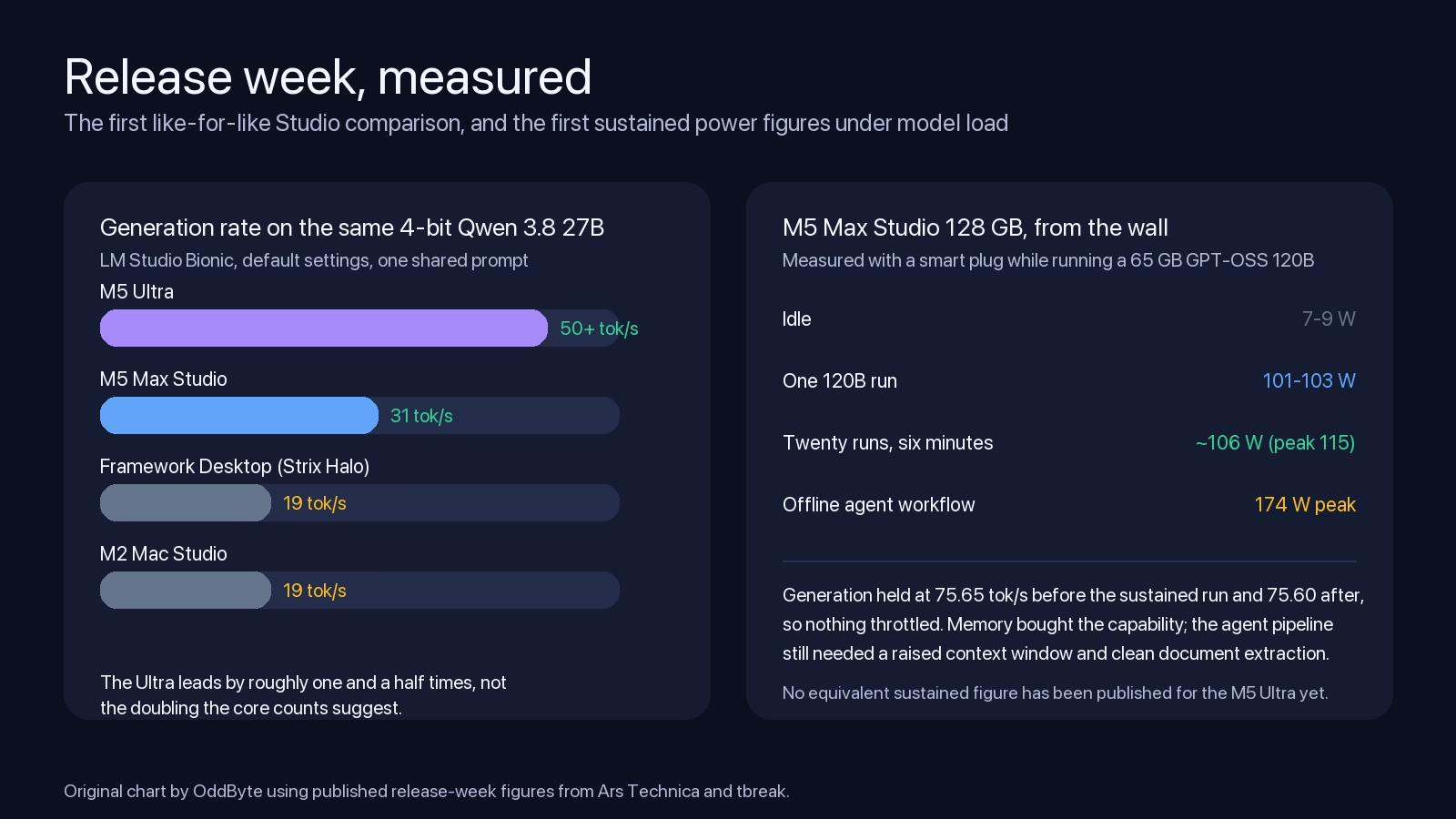
The cleanest head-to-head comes from Ars Technica, which ran the same 4-bit Qwen 3.8 27B model through LM Studio Bionic at default settings and read the generation rate off one shared prompt. The M5 Max Studio managed around 31 tokens per second. The M5 Ultra managed just over 50. A Framework Desktop built on Strix Halo and a two-generation-old M2 Mac Studio both landed at 18 to 20. The Ultra's bandwidth advantage is real, but on a fitted 27B it shows up as roughly one and a half times the Max rather than the doubling the core counts imply.
The 128 GB machine now has measured agent evidence of its own. Tbreak ran an M5 Max Studio through MLX and Ollama on models that fit and models that barely do: a 65 GB GPT-OSS 120B generated at 75.65 tokens per second, a 4-bit Llama 3.3 70B peaked at 41.2 GB and wrote at 13.1, and a 30B mixture-of-experts model reached 130.6. Then the reviewer disconnected the network and pointed OpenClaw at the local 120B model with a 16-page PDF. It pulled the specifications out in 49 seconds, after a 32K default context too small for the agent's instructions, tools, and the document together was raised to 64K, and after a broken PDF extraction step was fixed. Memory bought the capability; it did not make the pipeline work by itself.
Power figures arrived with it. From the wall: 7 to 9 watts idle, 101 to 103 watts during a single 120B run, and about 106 watts across twenty consecutive runs over roughly six minutes, peaking at 115. Generation was 75.65 tokens per second before that run and 75.60 immediately after, so nothing throttled. The heavier agent workflow peaked at 174 watts. Ars, measuring video encoding rather than inference, saw both chips draw about 75 watts.
Prices are firm now. The M5 Max Studio starts at $2,499 with 32 GPU cores and 36 GB. The 40-core, 128 GB, 4 TB configuration is $6,899, the base M5 Ultra with 96 GB is $5,499, and going from 96 GB to 256 GB adds $4,000.
Two things did not change. Every published M5 Ultra measurement still comes from the 256 GB, 80-core machine, so the base chip's prompt processing remains a projection. And the memory ceiling is harder than the capacity figures suggest: reviewers watched a 256 GB machine kill Flash-Next at 6-bit, while a 96 GB system hands roughly 86 GB to the model once the operating system, runtime, and cache take their share. That is why community threads arguing about these two machines keep landing on the same advice: buy the memory for the model you actually intend to run.
The recommendation for an agent workstation
For a general local-agent host, the preliminary choice is still the M5 Max with 128 GB, and launch week made that position easier to defend rather than harder.
Agent sessions begin with system instructions, skills, tool descriptions, memory, and working history, and research and coding loops keep adding context. Browser automation, builds, image tools, and local subagents all compete for the same unified pool. The release-week numbers show a 128 GB Studio running a 65 GB agent model at interactive speed for minutes at a time while drawing about 106 watts. Memory headroom turns those workflows from a tuning exercise into something that can stay running.
The 96 GB Ultra remains the better specialist: fewer compromises in token speed, but more discipline about which model is loaded and how many jobs run beside it. Its measured advantage on a fitted dense model is around one and a half times the Max, while the reviewed 256 GB machine leads on prompt processing by a wide margin. If a review of the exact 64-core, 96 GB machine shows it keeping most of that prefill advantage, the calculus for a single-model, long-context agent host gets much closer.
For now, the 128 GB Max is the balanced purchase. It is fast enough for interactive agent work, fits more of the models worth testing, and has room for the messy parts of real automation that clean benchmark runs leave out. The next round should compare both machines with identical models, quantizations, context lengths, and concurrent requests. The recommendation may then become firmer, or it may flip.