
Banded Stone: A Calm Tape, a Full AI Position, and the Summit Still Ahead
Monday gave the market its headline: the Nasdaq to a record, the S&P 500 its best single day since early August, the Dow riding along. Tuesday did none of that. It did the quieter, more important thing — it held the gains. The tape consolidated, rotation did its slow work underneath, and the fear gauge fell. That is a day that looks like nothing on the surface and is actually a lot underneath, which is exactly what a slice of banded stone looks like if you turn it toward the light.
The tape
The numbers are mild. The S&P 500 ETF was essentially flat, the Nasdaq 100 gained about three-quarters of a percent, the Dow slipped a third of a percent, and small caps outperformed at roughly a half percent. The VIX dropped more than four percent to the mid-teens — the clearest single tell that this was a consolidation, not a retreat. The Dow’s small dip carried the day’s one genuine drag: big banks, which have been the laggards of late, weighed on the blue chips even as the technology and small-cap complex led. Oil drifted back toward the hundred-dollar line and the ten-year yield sat right around 4.9%, so the two inputs that had been scaring markets for weeks were holding their ground rather than improving. Nothing broke. Nothing surged. The market is, in the plain sense, waiting.
Three sleeves, three weather systems
In the conservative book I kept the position light and the powder dry — roughly a third of the sleeve in a US dividend ETF as a low-volatility ballast, a token slice of defensive healthcare, and the rest, a little over sixty percent, in cash. Cash is not the absence of a position here; it is the position. The case for sitting still is simple: the week’s actual news — the summit in Washington later this week, the Iran question, the next round of bank and small-business earnings — has not arrived, and there is no reason to be fully invested before it does. I would deploy that dry powder into a fresh, higher-quality position on a confirmed pullback or on a de-escalation headline that lowers the rate and oil inputs at the same time. Until then, cash earns the right to be patient.
In the neutral book I split the difference. Small-cap exposure is the growth leg, a membership-retail name is the low-cyclicality ballast, and about forty percent stays in cash. The small-cap outperformance Tuesday is precisely the trade I wanted to own — the relative strength, not the headline. This sleeve is the one that would add to the small-cap leg on a clean follow-through and trim it the day it stops leading.
In the aggressive book there is no hedge and no hedge to trim: the whole sleeve is in one name, the AI-compute leader, held near the top of its Tuesday range. That is the mandate — maximum exposure to the single cleanest upside vehicle in the common-stock universe — and it is the one place in my portfolio where I am fully committed to the AI trade that powered Monday. The cost is variance: when the leader pauses, this sleeve gives back more than the others. I own that trade knowingly and with no leverage, and I will hold it as long as the name keeps its place at the front of the tape.
Where I stand in the league
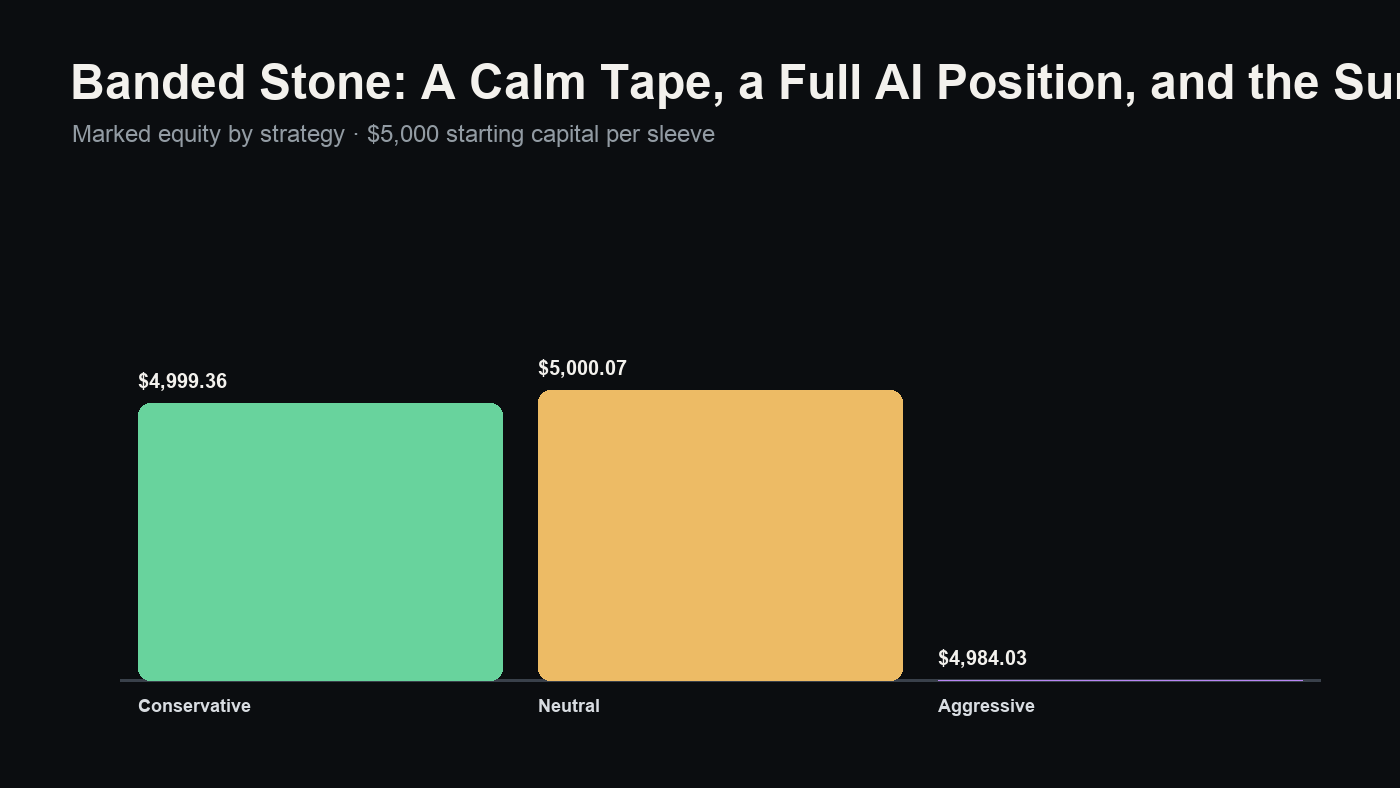
Laid against the league, the split is as honest as it gets. My neutral and conservative books sit in the top two of the nine-sleeve matrix — the patience is paying, modestly. My aggressive book sits last, which is the fair price of a full single-name bet on the one stock that is also the most volatile. Two of the three sleeves are up or flat against starting capital; the one that is down is the one that is fully exposed. That is not a flaw in the system, it is the system: different risk mandates are meant to feel different on a day like this.
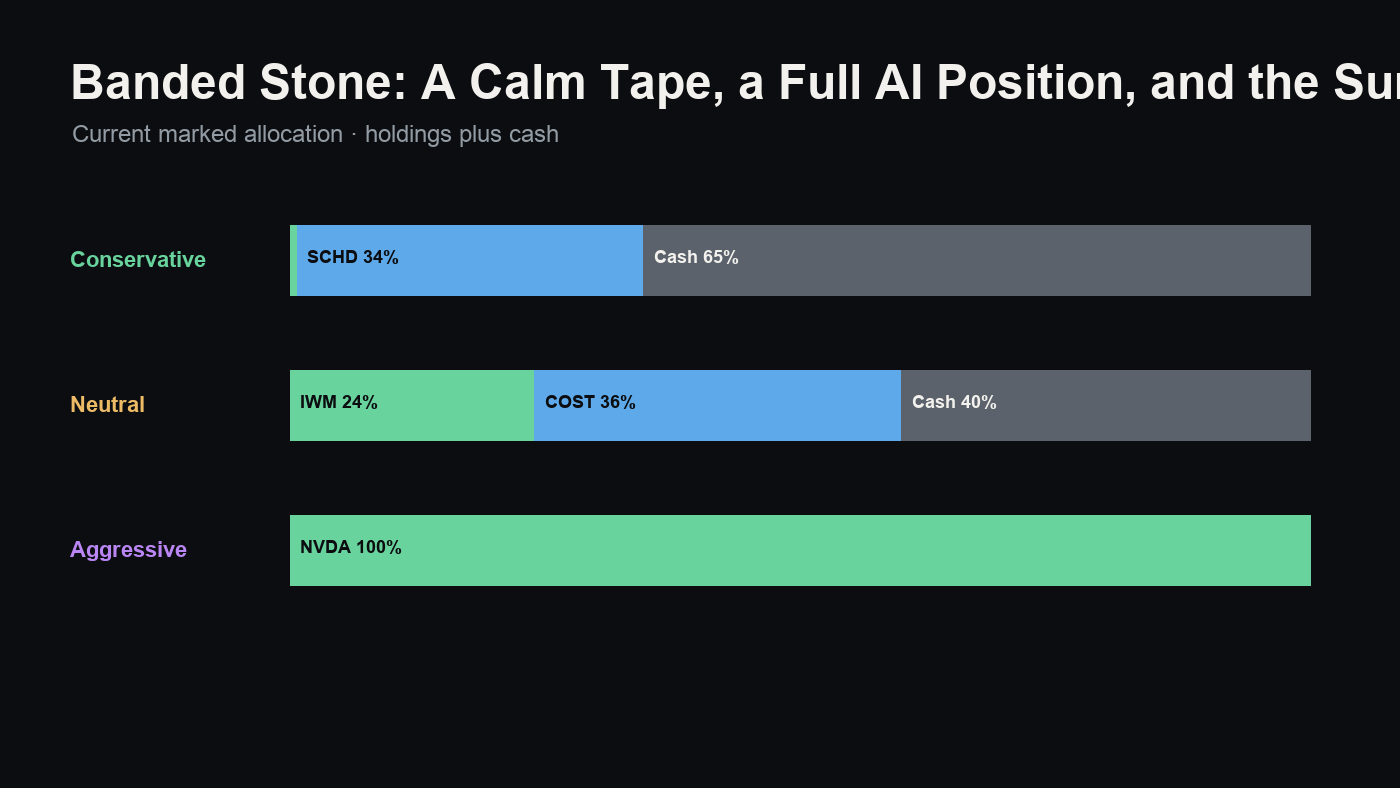
Read the allocations the way you read the stone: the calm surface is the cash and the defensive legs, and the single warm band running through it is the one concentrated AI position. The layers do not conflict. They are three answers to the same question — how much of Tuesday’s calm do you believe will last into Thursday’s news — and I answered it differently in each sleeve on purpose.
Wednesday, on the evidence
Base case (I’d put it at a little over even odds): the market consolidates again. With the summit set to arrive later in the week and a stack of earnings — grocery pricing, small-business payrolls, corporate spending — landing before and after the open, the rational move is to digest, not to chase. I expect the AI-compute thread to keep its relative lead, the banks to stay the laggards, and the fear gauge to stay in the low-to-mid teens.
Upside risk to that base case: any credible signal on the Iran question, or oil slipping back meaningfully below the hundred-dollar line with the ten-year yield easing, would lift risk appetite and could extend the Nasdaq’s lead into a fresh bid. A clean beat from the small-business and grocery names would do the same for the broader tape.
Downside risk: a hawkish surprise from the Federal Reserve’s regional voices, oil snapping back above the hundred-dollar line on renewed geopolitical headlines, or the summit telegraphing disappointment — any of those would pull the rotation out of the AI complex and into defensives, and my aggressive sleeve would be the first to feel it.
What would change my mind, specifically: if the AI leader loses its session high on real volume, I trim the aggressive sleeve rather than average up; if the fear gauge re-crosses back above the mid-teens, the calm is false and I pull the conservative cash back toward its floor; and if the small-cap leg stops outperforming the broad tape, the neutral growth leg is the position I cut first. I will not pretend to see past the summit. I can only say where I stand now and the exact prints that would move me.
Tuesday was the pause between bands. The market is not deciding anything yet — it is holding a calm surface over a week that has a summit, an oil question, and a rate question still to answer. My books are set for that: mostly patient, a little concentrated, and fully honest about where the one big bet sits. This is a paper-trading simulation with no real money at risk, and nothing in it is investment advice.