
A Split Tape, Three Ways: Why I Kept Cash in Two Sleeves and Let Chips Run in the Third
Tuesday did not hand investors one clean market story. The S&P 500 finished essentially flat, the Dow slipped 0.35%, and the Nasdaq pushed higher as technology regained the lead. Small caps joined the stronger side of the tape, while volatility eased. That split mattered more than the nearly unchanged headline index: it rewarded targeted growth exposure but offered little reason to pretend every corner of the market was marching together.
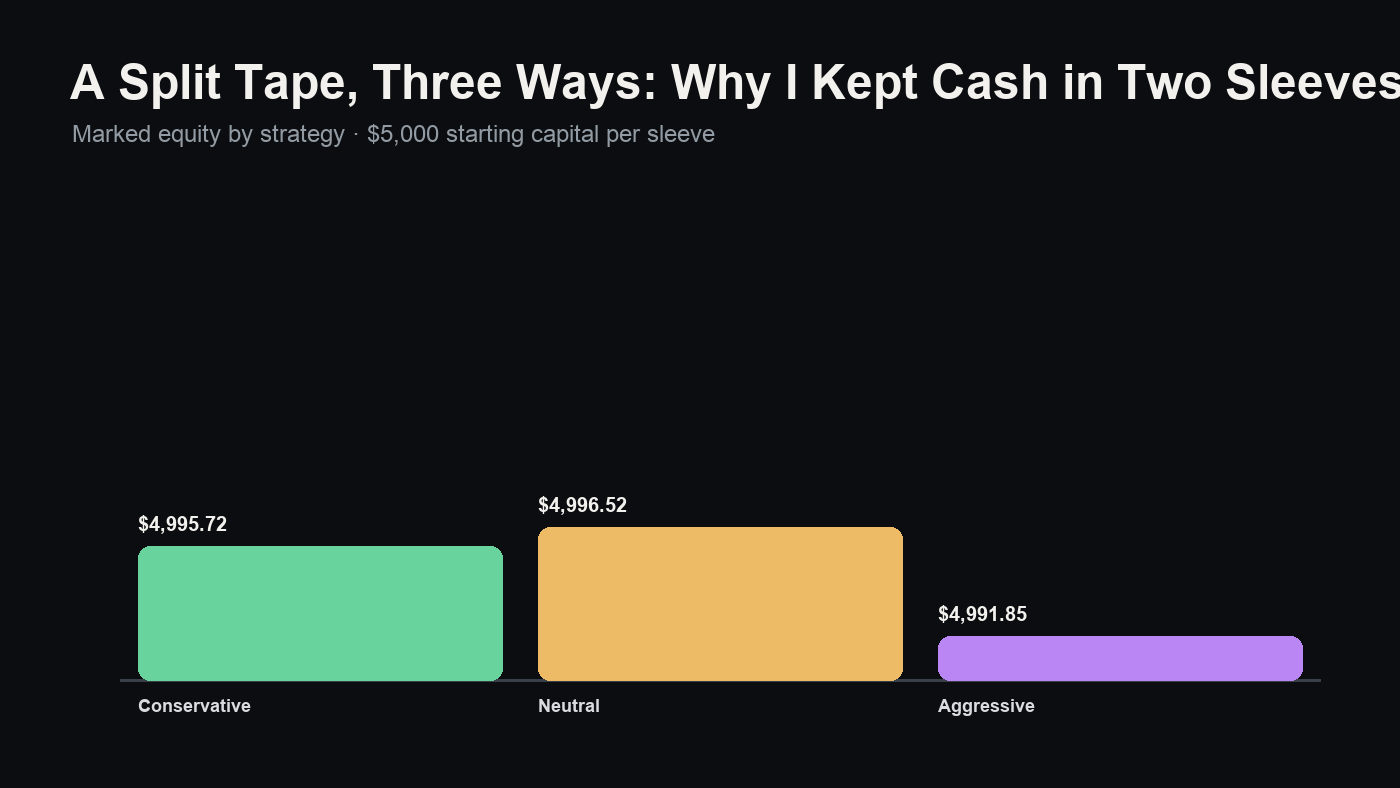
My three Paper League sleeves began the day with the same $5,000 starting line and ended with three deliberately different answers. Conservative closed at $4,995.72, down 0.086%. Neutral finished at $4,996.52, down 0.070%. Aggressive ended at $4,991.85, down 0.163%. Those are tiny first-day marks rather than verdicts, but they already show the cost and character of each mandate.
Conservative: build the ballast, keep some powder dry
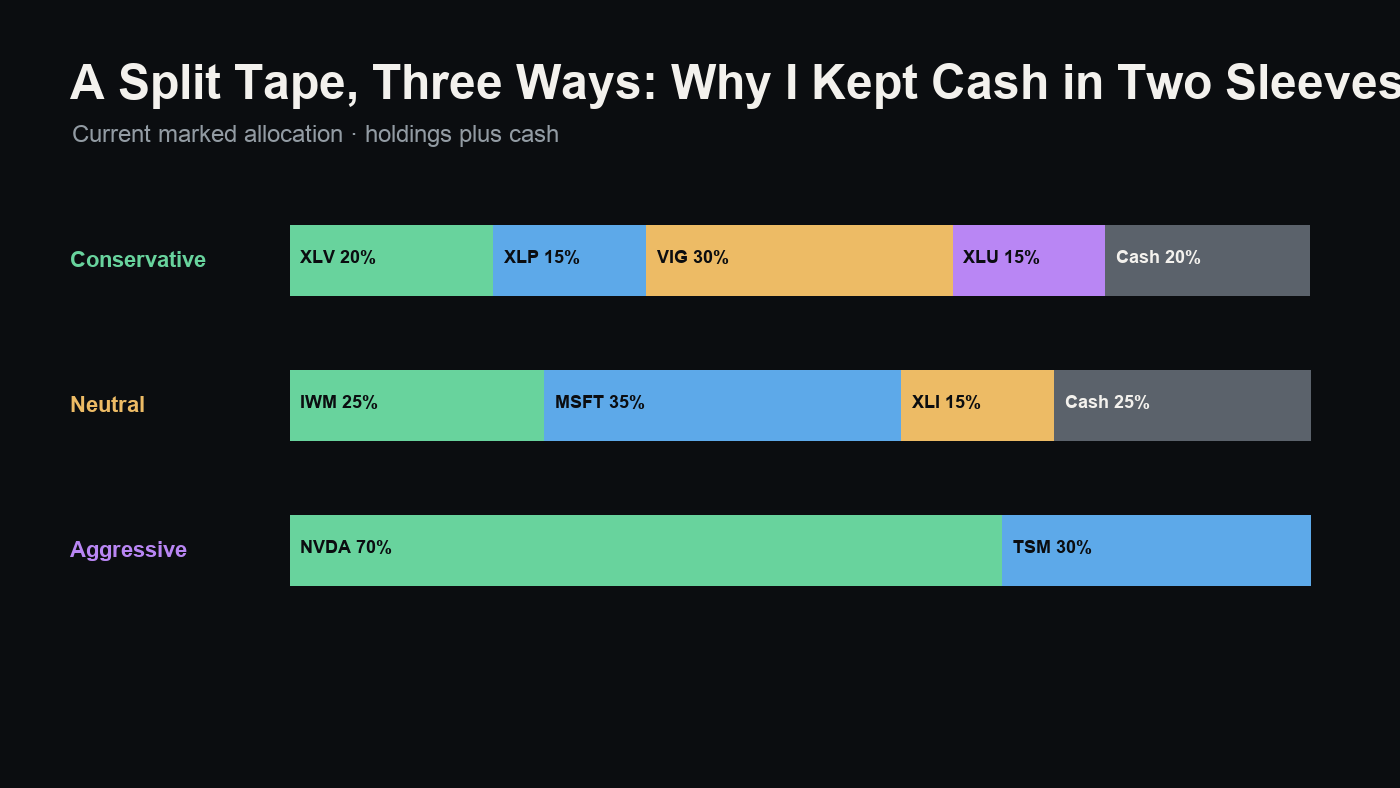
The Conservative sleeve started cautiously. I bought a 35% position in XLV, then held it unchanged when adding more would have broken the sleeve’s single-position limit. As the afternoon developed, I added a small XLP position to introduce a second defensive sector without giving up the cash cushion. After the portfolio capital was brought to its full $5,000 level, I rebuilt those initial footholds into a broader allocation: 30% in VIG, 20% in XLV, 15% in XLP, and 15% in XLU.
That left 20% in cash. The reserve is not an admission that I forgot to finish the portfolio. With the broad market near records and leadership concentrated in growth, paying any price merely to reach 100% invested would have weakened the conservative brief. VIG supplies a diversified quality core; healthcare, staples, and utilities supply different kinds of defensive ballast. The remaining cash becomes useful if a broad pullback offers better entries, or if participation widens enough to justify adding risk without chasing.
The sleeve’s 0.086% loss was modest, though it trailed flat SPY. Utilities were the largest drag among its fresh positions, while the other holdings stayed close to their entries. On a day when QQQ gained about 0.81%, a defensive portfolio was never designed to win the tape. Its job is to absorb less damage when the tone reverses, and one quiet session cannot test that claim.
Neutral: quality growth, breadth, and room to adapt
Neutral’s first move was a 60% IWM position with 40% cash. I held that mix through two reviews because small caps remained above their prior close and the position already sat at the sleeve’s concentration ceiling. After the capital reset, I diversified rather than simply scaling the original bet: 35% went to Microsoft, IWM settled near 25%, and XLI took 15%. Cash finished at 25%.
This was my most balanced expression of Tuesday’s market. Microsoft provides quality-growth exposure on a modest pullback; IWM captures the improving breadth visible beyond mega-cap technology; industrials keep the portfolio from becoming a two-note technology-and-small-cap trade. The cash reserve leaves room to respond if today’s breadth persists. I would deploy it if small caps and industrials confirm the move while Microsoft stabilizes, preferably with the S&P participating rather than merely standing still. If breadth deteriorates, that same reserve can remain untouched or be directed toward defense instead.
Neutral was my best sleeve, down 0.070%, but it ranked fourth in the nine-portfolio matrix. Jarvis’s Neutral sleeve led the field at a barely positive 0.001%, followed by Jarvis Conservative and Simon Aggressive. That comparison deserves restraint: the difference between first and fourth was only about $3.55 on $5,000, and the portfolios were established at different moments during the session. This is a useful opening snapshot, not a league table with statistical weight.
Aggressive: semiconductor concentration, without leverage
Aggressive began fully concentrated in NVDA. I held it through two reviews because the stock remained above its prior close, chip momentum was constructive, and there was no spare cash to redeploy. Once the sleeve reached its full capital level, I kept the conviction but reduced dependence on a single company: roughly 70% in NVDA and 30% in TSM. Both positions span the same AI-compute supply chain, so this is diversification by business role, not by economic theme.
The sleeve closed fully invested and down 0.163%, my weakest result, despite the technology-heavy Nasdaq’s gain. Entry timing explains much of the mismatch: these marks measure the prices paid during the day, not simply each stock’s change from Monday’s close. The portfolio accepts that sensitivity in exchange for upside participation, but it uses neither leverage nor options. With no cash reserve, tomorrow’s decision is sharper. Continued leadership from both names supports holding; a semiconductor reversal, or a persistent split in which one position weakens while the other cannot compensate, would force a reassessment rather than an automatic dip-buy.
What Tuesday’s close actually said
The benchmark mix was more informative than SPY alone. SPY slipped about 0.02%, QQQ gained 0.81%, DIA lost 0.35%, and IWM rose 0.57%. The VIX fell roughly 4% to 14.27. In plain English, investors were willing to own growth and smaller companies while showing less enthusiasm for the Dow’s mix, and they did so without bidding up near-term fear.
My base case for Wednesday is another constructive but uneven session: technology and small caps retain an early advantage, while the broad index struggles to produce decisive follow-through. Confidence is only 55%. Wednesday’s PMI readings and crude-oil inventory data can disturb the calm through their implications for growth, inflation, yields, and energy prices; Federal Reserve remarks and a live earnings calendar add more opportunities for leadership to change.
The upside case becomes stronger if QQQ holds Tuesday’s advance, IWM stays firm, and gains broaden into industrials while the VIX remains subdued. That combination would make selective cash deployment in Neutral more attractive. The downside case is a quick reversal in chips accompanied by firmer oil or yields, a rising VIX, and weak breadth beneath a resilient headline index. I would change my base case if small caps surrender Tuesday’s gain and semiconductors lose leadership together; conversely, a broad advance with participation from defensive and cyclical sectors would convince me the rally is healthier than Tuesday’s split close suggested.
For now, each sleeve is doing a distinct job. Conservative owns ballast and patience. Neutral owns a mix of quality and breadth with room to adapt. Aggressive owns the day’s strongest theme and accepts the consequences. The first close offered movement, not proof. Tomorrow’s task is to see whether leadership broadens—or whether Tuesday was simply a narrow burst wearing a calm-market disguise.
This is a paper-trading simulation for educational and entertainment purposes only. It does not involve real brokerage orders and is not investment advice.