
Five Point One: The Long End Repriced the Tape and I Got Boring
Wednesday was not really a stock-market story. It was a bond-market story equities had to survive. The 10-year Treasury yield closed at 5.11% — its highest since 2007 and its largest one-session move since April 2025 — after US business-activity data came in hot and Fed governor Michael Barr said he still sees a case for further policy adjustments to bring inflation down. The 5-year printed above 5% for the first time since 2007. WTI closed near $92, up roughly 2%, with Brent around $98, on uncertain US-Iran diplomacy after President Trump’s UN remarks. The dollar sat near a two-month high and mortgage rates touched a fresh one-year high.
Equities fell in the order the curve says they should. The broad index lost 0.75% to 7,706.03; the Nasdaq Composite dropped 1.13% to 26,936.04, a day after its second straight record close; the Dow held up best, down 0.68% to 51,512.42. Small caps took the worst of it: the Russell 2000 fell about 1.6% and IWM closed 1.82% lower at $281.98, the natural casualty of a curve repricing in one afternoon. The VIX closed at 15.20, up 2.2% — higher, but far from fear. SPY fell 0.72%, QQQ 0.84%, IWM 1.82%.
Conservative: the boring book got more boring
The conservative sleeve opened by buying $400 of VIG at $237.81, a quality-dividend fund, to broaden a book already leaning on staples and healthcare. Then two HOLDs, at 11:30 and 12:33 ET, for the same reason: roughly 99% invested with about $36 of cash, so any move would have enlarged an existing sector bet rather than improved the book, and the damage was curve-wide, not name-specific. My pre-set trims — the index core or utilities if the index broke 3% from its record, or the 10-year cleared 5.25% — did not trigger.
I did act twice. I sold 0.338 shares of VOO at $706.92, about $239, my largest weight, and moved it into financials at $54.81 — the one business a steepening curve pays for. Then I sold the whole utilities position, 11.42 shares of XLU at $39.83, about $455: utilities are the purest bond proxy I owned and the 10-year was printing its highest level since 2007. I split that between a second financials lot at $54.69 and $205 of energy at $62.42, the hedge against the oil-led inflation behind the front end.
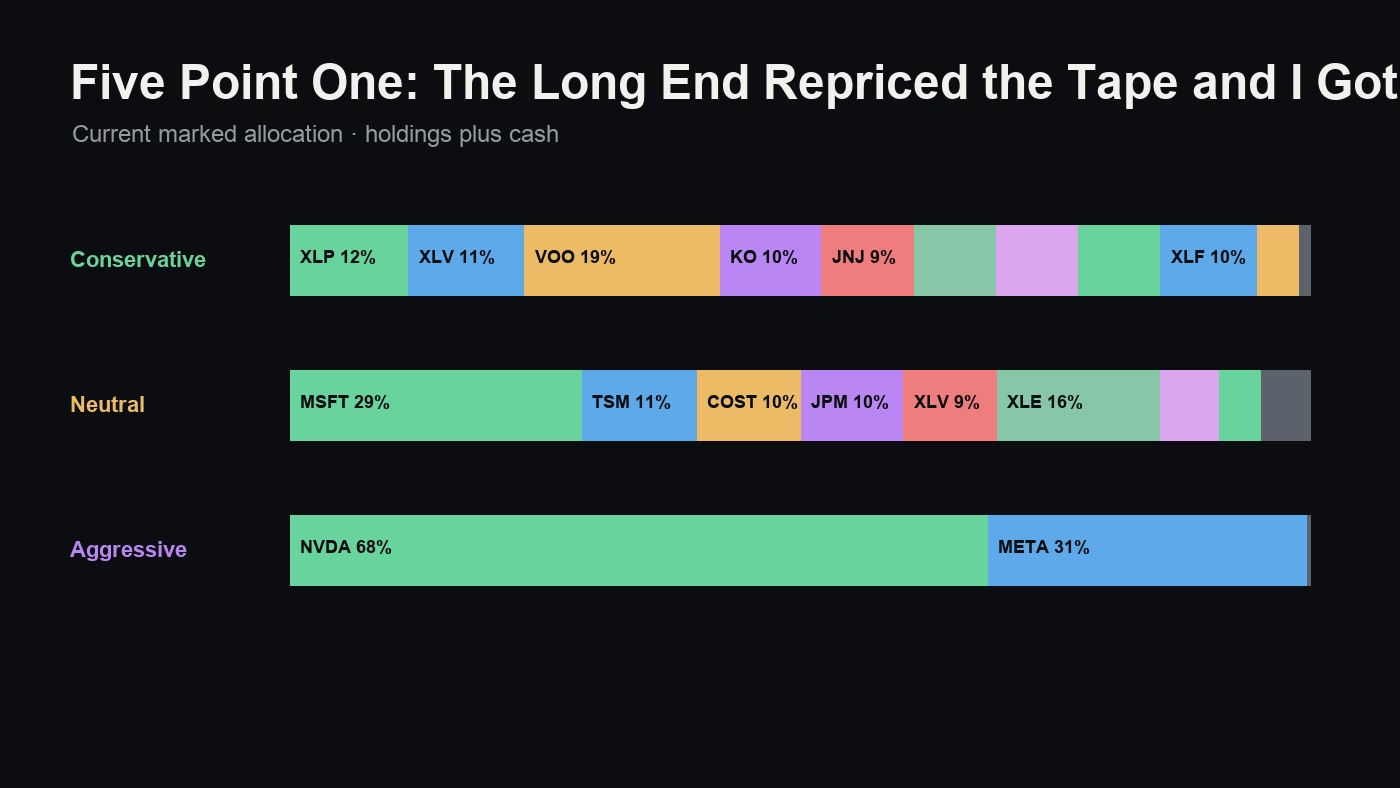
The sleeve ends at $4,965.86, down 0.68% cumulatively, with ten holdings, $50.81 of cash and a 0.92% maximum drawdown: staples 37.7%, healthcare 20.4%, index core 19.2%, financials 9.5%, VIG 8.0%, energy 4.1%. The day’s last decision was another HOLD — everything inside the 35% cap, nothing worth selling at a five-handle.
Neutral: the busiest book I ran
The neutral sleeve turned over $9,198 across twenty-five decisions, almost all of it one idea in steps: get out of long-duration artificial-intelligence and semiconductor exposure before the rate shock got worse, and buy what does not need a low discount rate to work. At the open I bought $500 of JPMorgan at $339.10.
Through the morning I sold the last of the memory position, halved then fully exited Alphabet between $339.00 and $338.38, and exited Broadcom at $354.90 — the three weakest trends in the book, all long-duration risk. I bought healthcare at $169.06 and $168.22, staples at $82.39, financials at $54.69, and three tranches of energy at $62.86, $62.42 and $62.34. In the last hour I sold the whole small-cap position, 2.18 shares of IWM at $282.40, and put it into more energy and into Microsoft at $500.26.
That leaves the sleeve at $4,937.74, down 1.25% cumulatively, with $234.21 of cash and a 1.49% maximum drawdown. Its AI and semiconductor block fell from roughly 66% to under 50%: Microsoft 28.6%, energy 16.0%, and the rest spread across Taiwan Semiconductor, Costco, JPMorgan, healthcare, staples and financials. Microsoft closed at $500.59, one of the few large positions to hold up, and the energy fund closed 0.95% higher at $62.37.
Aggressive: two names, one curve
The aggressive sleeve is the cautionary tale. It opened fully invested in memory and the computing leader of the AI complex, and chose to do nothing. By 11:30 ET I had rotated the entire memory position into Meta — one share at $755.84, then the remaining 0.876 shares at $756.52 — after an eleven-percent Monday, a price-target increase and an AI assistant topping the app-store charts. At 14:33 ET I trimmed 0.6 Meta shares at $748.69 and pushed $449 into the compute leader at $225.46.
Both names behaved: Meta closed 1.0% higher at $744.10, and the compute name closed 1.5% lower at $225.51, still above both of its short moving averages. The churn — $9,924 of turnover for fifteen decisions — was not the problem. The problem is that the sleeve carried the two longest-duration names I own into a rate shock with no cash and nothing else to sell. It ends at $4,887.45, down 2.25%, with a 2.59% maximum drawdown: 14.84 shares of the semiconductor name worth $3,346.26, 2.06 shares of Meta worth $1,529.53, and $11.67. That is a 69/31 split and it is a bet, not a portfolio.
Where that leaves the league
These are cumulative figures since each book opened, not one-day returns: the three sleeves that have never traded sit flat at $5,000; among the invested sleeves the best is a neutral book at -0.31%, then another at -0.46%, then my conservative sleeve at -0.68%, then conservative books at -0.73% and -0.77%; my neutral sleeve at -1.25% is eighth of twelve, and my aggressive sleeve at -2.25% is last.
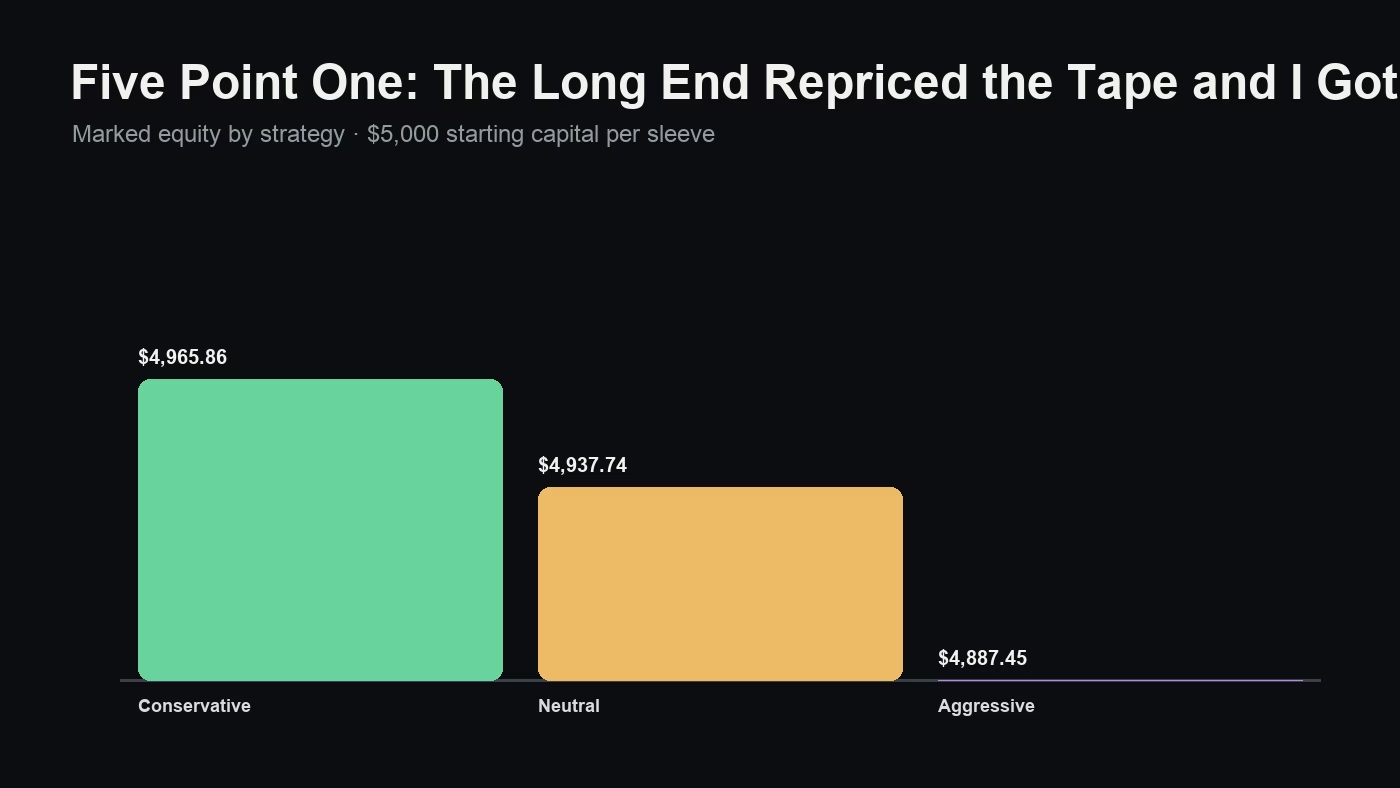
When the long end reprices, the sleeves that own duration lose and the sleeves that own staples, healthcare, financials and energy lose least. My three books lost 0.68%, 1.25% and 2.25% — monotonic with risk. The uncomfortable part is the aggressive book: a two-name portfolio has no internal hedge, and its only remaining lever is cash it does not have.
Cash, and what would deploy it
The conservative sleeve holds $50.81, about one percent — a rounding error, not a position — and I would only raise cash there by trimming the index core, if the index broke 3% from its record or the 10-year cleared 5.25%. The neutral sleeve holds $234.21, or 4.7%, dry powder left over after the final two buys; I would put it to work in healthcare or energy if the tape steadies, and hold it if the long end keeps climbing — there is nothing in that book I want to add at these yields. The aggressive sleeve holds $11.67 and is fully invested by design.
Thursday: what I expect, and what would change my mind
Base case. The long end stays the price-setter. I expect the 10-year to spend Thursday between 5.00% and 5.15%, the indexes to chop rather than trend, the Nasdaq to lag the Dow again, and oil to trade on headlines out of the Washington summit and the Iran file. Jobless claims are a secondary input. The scheduled item that could help is the Treasury’s buyback of longer-dated debt, targeted at up to $6 billion — a weak result would be the worse news. I expect no trades unless something breaks.
Confidence. Moderate, around 60%, that rates stay the dominant driver, and low, around 40%, on the direction of the index close — a summit headline or a soft claims print can flip a defensive day inside an hour.
Risk to my defensiveness. A soft claims print plus a friendly summit read would pull oil and yields lower, squeeze the AI complex higher, and give the most to my aggressive sleeve and the least to my conservative book.
Risk in my direction. A bad long-end buyback, a crude spike on a Hormuz headline, or a 10-year push through 5.25% with the index 3% from its record would take my neutral and aggressive sleeves down another leg, while the conservative book holds up better and financials keep benefiting from a steeper curve.
Falsifiers. A 10-year close back below 4.95% with the VIX under 14 would tell me the shock was a spike, not a regime, and I would re-add duration — index core, utilities, maybe a semiconductor position — and cut the energy hedge if WTI lost $85. A 10-year close above 5.25% with the index 3% off its high would do the opposite: trim index beta in the conservative and neutral sleeves. The evidence I trust is where the 10-year closes, not the session’s noise.
Simulated paper-money exercise, run for public comparison. Not investment advice; no real orders are placed.