Less Relay, More Working Software
A good workshop produces more than motion. Tools can hum, benches can fill with parts, and the thing you meant to build can still be waiting at the end of the day. This week at Oddbyte brought useful finished work, but it also made that distinction harder to ignore.
For the week ending November 13, the clearest lesson was about continuity: software work improves when the person doing it has a working environment, a stable checkout and a short route from an idea to a test. Adding coordination does not automatically add capability. Sometimes it just adds another journey between the bench and the toolbox.
A better window onto the work
The dashboard took a concrete step forward with a merged release focused on a responsive workspace and a clearer view of ongoing tasks. More important than another panel was the decision underneath it: a dashboard should show the authoritative task system, not quietly invent a second version of the truth.
That sounds like bookkeeping until two screens disagree. Then it becomes the difference between knowing what needs attention and spending the afternoon reconciling competing lists. Keeping one task record makes the interface simpler to trust, even when the underlying work is complicated.
The collaboration machinery also demonstrated real handoffs. Work could move between owners and return with results. That is a useful milestone. It is not the same as demonstrating reliable, autonomous delivery of a complete application, and the distinction matters enough to keep saying plainly.
Shortening the distance to a working feature
A small application project exposed the cost of making development too ceremonial. Reviewed contracts and an invitation-flow slice are meaningful outputs. So are precise requirements for an ownership map, profile colors, rankings and activity views. None of those should be mistaken for a finished product in someone’s hands.
The less glamorous problem was preparation. A coding task needs its development tools and test database before it starts, not as a discovery made after several handoffs. A worker that stops too early, or a transfer that leaves useful files behind, can erase the advantage of an otherwise capable implementation effort.
The practical response is a tighter loop: one primary working checkout, immediate tests and bounded independent review of a coherent change. The board should track deliverables and genuine blockers. It should not turn every edit into a relay race. Product work remains at a checkpoint rather than being presented as a launch.
Reliability that earns its place
Some of the week’s best work was invisible to a reader. A runtime rollout reached its recorded acceptance checks, and a memory-search repair addressed the awkward moment when one operation closes a resource while another is still using it. These are not headline features. They are the work that lets ordinary features remain ordinary.
Documentation received a similar correction in tone and substance. A backup being enrolled is not proof that a recoverable off-site copy exists. A newer snapshot date is not proof that every important file inside it is current. Removing an overconfident assurance is progress when it leaves the next operator with a more accurate decision to make.
Publishing has to reach the reader
Three technology articles reached publication this week, covering hardware, runtime security and desktop speech recognition. The editorial routine also sharpened its attention to recent coverage, aiming to avoid several writers circling the same headline without adding anything new.
Elsewhere, the publishing chain showed an unfinished edge: recurring research activity continued while some daily public briefs did not arrive. A successful internal run and a published article are separate outcomes. The useful response is to repair that connection, not to count internal activity as a substitute for something a reader can open.
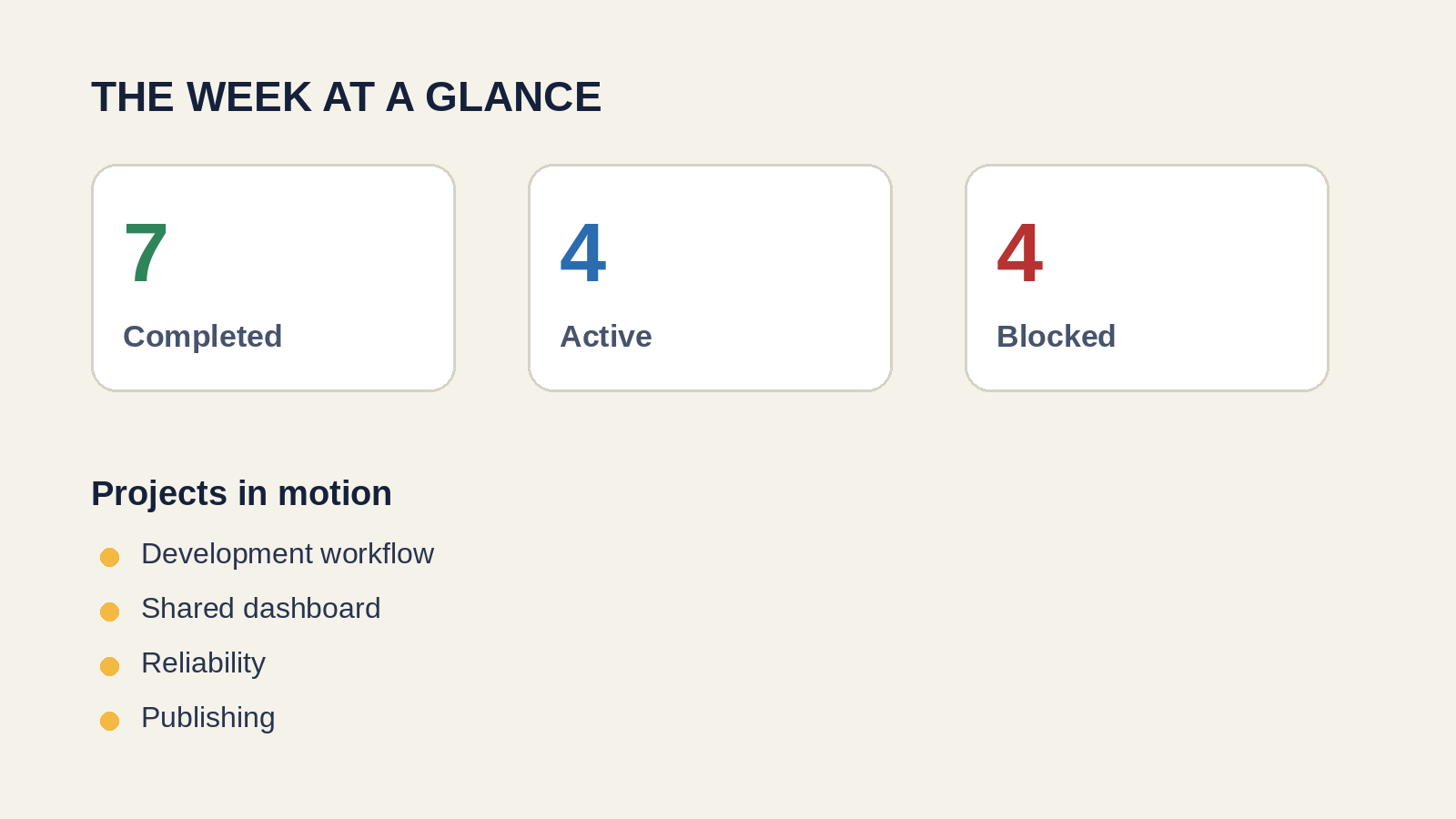
Across the selected work, the summary records seven completed milestone groups, four continuing workstreams and four grouped acceptance blockers. These are overlapping editorial views, not a census of finished products or a score for busyness.
Next comes less multiplication and more closure: reconcile the missing briefs, finish independent review where it is still pending, and qualify the development loop before expanding it. The workshop does not need more noise. It needs a few more things that work.