Container Updates, Measured: 43 Differences Down to Six
Turning on automatic updates is easy. Demonstrating that containers actually changed—and that the update mechanism can keep doing its job—is the part worth measuring.
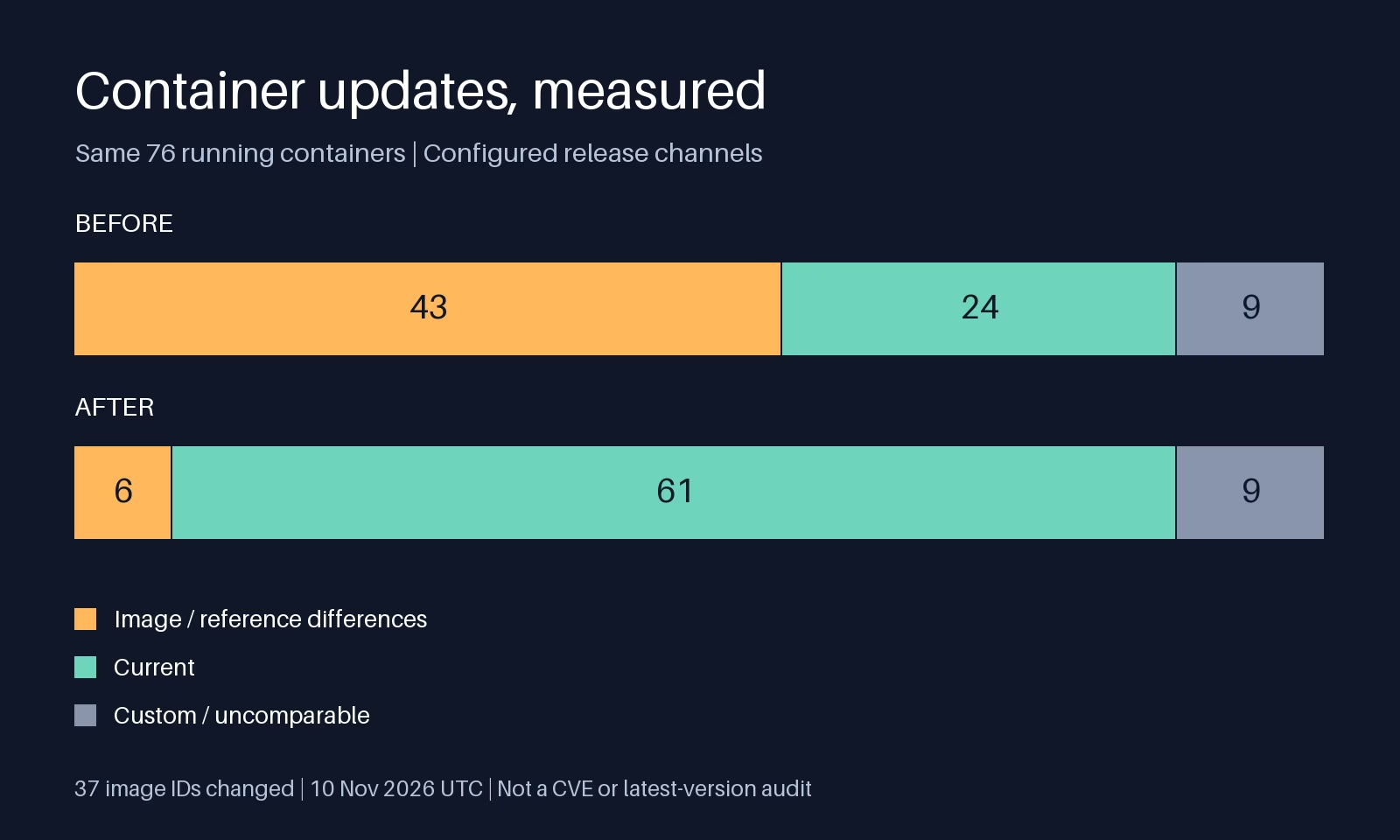
This rollout began with 76 running containers. A comparison against their configured tracking tags found 43 image or manifest-reference differences, 24 current containers, and nine custom-built containers that could not be graded against a maintained registry channel. The follow-up snapshot found six remaining differences, 61 current containers, and the same nine custom builds. Thirty-seven containers were running different image IDs.
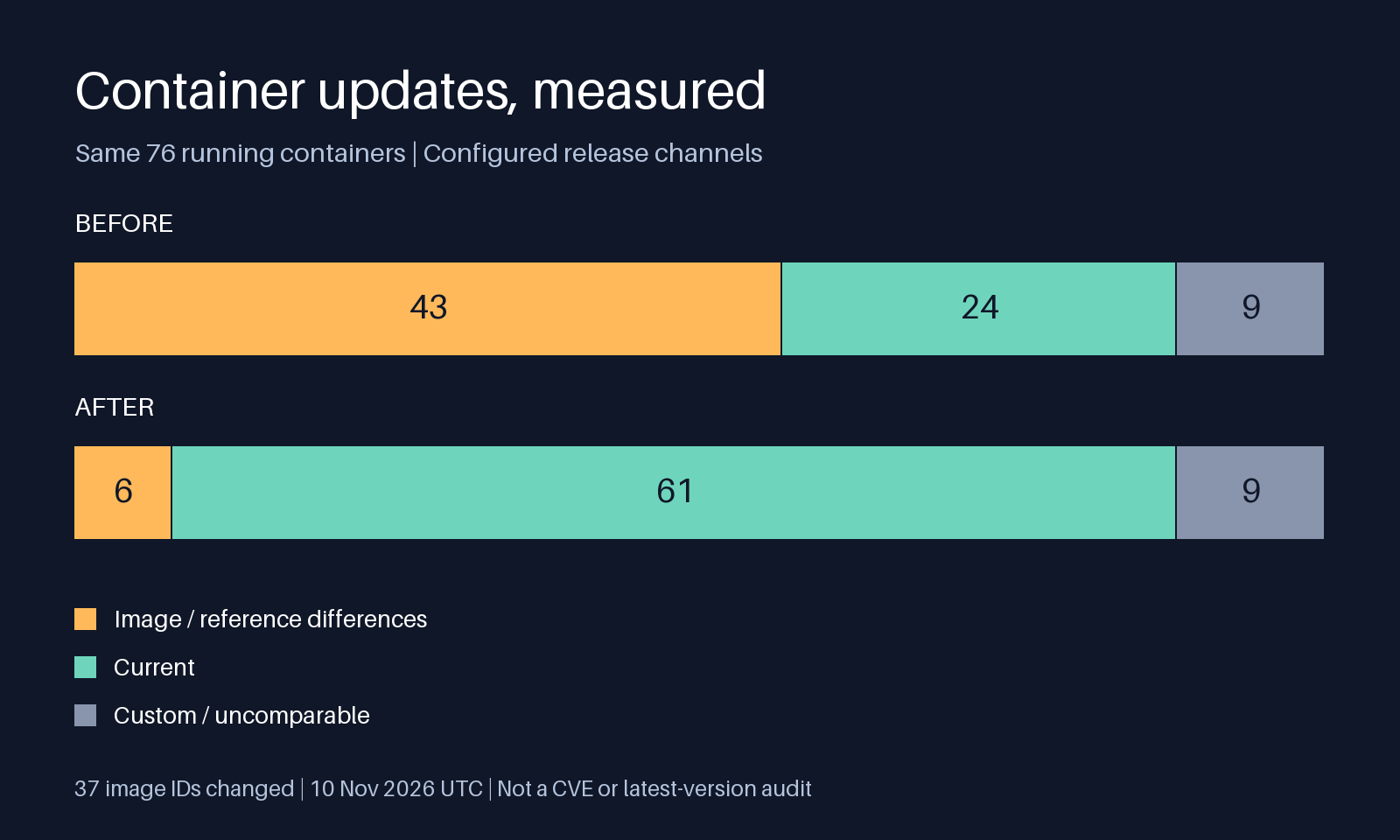
The before and after
Both inventories covered the same running service identities: 63 Swarm services represented by 67 task containers, plus nine standalone containers. Five stopped service definitions remained stopped and were excluded from the running-container comparison.
| Running-container measure | Before | After |
|---|---|---|
| Image or manifest-reference differences | 43 | 6 |
| Current on configured tracking tags | 24 | 61 |
| Custom-built, not registry-comparable | 9 | 9 |
| Total running containers | 76 | 76 |
The before snapshot was taken on November 10, 2026 at 05:16 UTC; the after inventory began at 14:10 UTC, followed by fresh registry comparisons. These are measurements of image availability on configured release channels, not a vulnerability scan or a claim that every application is on its newest upstream release.
The distinction matters. Nine of the original 43 differences were manifest-only comparisons where the available evidence established a changed index or manifest, not a different ARM64 image configuration. One such comparison remained afterward. The other five remaining container differences came from ARM64 image-configuration comparisons. Those subsets are included in the totals, not additional containers.
Two update mechanisms, with separate responsibilities
Komodo now has update polling and automatic updating enabled on all 38 managed Swarm stacks, with empty service skip lists. Databases were not excluded. Its existing daily Global Auto Update procedure remains enabled, and the repository template carries the policy forward for newly declared stacks.
Watchtower remains responsible for eligible standalone containers. All nine standalone containers were current on their configured tags in the follow-up comparison. That does not mean every tag follows the newest software release: a fixed version tag can remain current as an image while a newer application release exists elsewhere.
Komodo is not a universal updater for every Docker object merely because it can see a Swarm. Unmanaged services still need an appropriate ownership and enrollment path. Custom images need reproducible builds, publication, and usable registry authentication. A successful image-publishing workflow alone does not establish that a deployment can pull it.
What the rollout actually caught
A controlled stateless canary came first, followed by bounded application batches. Native operation results were checked against actual Swarm tasks and image references. Protected configuration checks covered placement, replicas, environment, mounts, secrets, and rollout settings.
That distinction caught real problems. An update operation could report success while Swarm had restored an older image. Monitoring images rejected legacy configuration formats; those required a versioned configuration migration, not another blind restart. A frontend briefly failed to resolve its backend during a rolling transition and recovered after a targeted, validated retry.
An inline deployment definition also lagged behind live settings. The runtime checks caught the drift, and the affected settings were restored to both the running service and its persistent deployment definition. The lesson is practical: changing only an image line does not make redeploying stale source harmless.
For stateful workloads, compatible database-major channels were preserved. Native SQL captures and a checked SQLite backup were created where exercised; a failed or tiny capture was not counted as a usable backup.
Six remaining differences are not an all-clear
The measured remainder includes unmanaged test fixtures, an application that returned to its previous image through rollback, a database-backed application whose fresh backup qualification failed, and the manifest-only comparison. Subsequent investigation of a test-fixture update encountered a registry-access warning and a paused rollout; its previous image was restored and both replicas were verified running. It was not counted as an upgrade.
The nine custom-built containers are a separate coverage gap, not nine containers silently declared current. Their qualified patches and existing behavior were preserved rather than replacing them with convenient but unqualified upstream images.
The result is a substantial, verified reduction—not a manufactured zero. Thirty-seven image IDs changed, the running-container count stayed at 76 in the measured comparison, and the remaining exceptions are explicit. Future checks should use that same standard: inspect what is running, distinguish reference drift from software versions, and never confuse an enabled update setting with a completed rollout.