A Week of Results That Survived a Second Look
A Week of Results That Survived a Second Look
The most useful moment in an experiment often comes after the impressive demonstration. Someone opens the finished page, asks whether the result really means what it appears to mean, and finds the detail that changes the story. This week at Oddbyte, those second looks mattered more than another round of ambitious promises.
There were long-context model tests, a much larger image gallery, a repaired knowledge library and some decidedly unglamorous recovery work. Together they made a good case for a simple standard: a result should still be useful after the excitement has worn off.
The smaller contender earned its place
The local AI experiments began with a practical question: what can a well-equipped desktop actually sustain when the conversation is long and more than one assistant wants attention?
The answer was more interesting than a ranking by model size. A thinking-enabled smaller model completed the entire matched twelve-task packet, while its non-thinking configuration performed substantially worse. A heavyweight alternative also showed that two clients could share one loaded set of weights for sustained work. Neither result made waiting disappear. Fresh, lengthy inputs could still turn an apparently responsive setup into a several-minute exercise in patience.
That distinction became the heart of the published findings. Warm follow-ups and cold starts are different experiences. A configured context limit is not the same thing as a conversation that has genuinely occupied it. Keeping a model in memory is not proof that it completes the task correctly.
The public technical edition now lets readers inspect task results and timing differences rather than rely on a single headline. It also leaves the limits visible: bounded tests can identify promising candidates without establishing the best assistant for every ordinary day.
A gallery that keeps its mistakes
The image experiment grew from five prompts into a ten-prompt comparison across seven model entries. The finished gallery contains sixty scene outputs from six models, alongside seven visibly corrupted outputs from the remaining model. Three further prompts in that last series were deliberately not run.
Keeping the damaged images was important. A file can be a perfectly valid image file without depicting anything useful. Early technical checks were not enough; visual inspection caught the repeated patterns that made the original success claim untenable.
The gallery now gives those failures their proper label rather than hiding them behind blank cells or replacement pictures. It does not pretend that a broken generation path establishes the model's artistic ability. The unresolved question belongs to the exact runtime and decoding setup, which needs investigation before another batch deserves anyone's time.
There is also a working local image-tool implementation with a real inspected canary. That is encouraging, but implementation and everyday availability remain separate milestones. Finishing the tool does not automatically finish its integration for every intended recipient.
Making the library worth opening
Documentation work is easy to celebrate by counting pages. The more useful question is whether a reader knows where to go next.
This week's library repair restored and consolidated application material into a flat, alphabetic collection, with separate homes for trials and retired applications. Empty organizational containers were retired only after checking that they were actually empty. Existing source references and substantial operating detail were preserved.
The cleanup also kept uncertainty in the right place. Conflicting deployment details were flagged rather than filled in with plausible guesses. That is less tidy than declaring the whole collection validated, but considerably more helpful to the next person trying to use it.
Recovery without cosmetic reassurance
The infrastructure work brought a less comfortable lesson. A configuration mistake interrupted the backup controller, and an initial process check was not strong enough to catch the problem. Repair meant acknowledging that error, restoring stable operation and then recovering the missed work through its real producers and validators.
The subsequent recovery included actual copy verification, sampled restores and revised qualification logic. The checks distinguish a newly captured generation awaiting its next copy from an overdue generation that should already be protected. They do not label pending bytes as verified protection.
Some old applications were also retired reversibly, preserving recovery material while removing their active operation. Other gaps remain open, including a native media-backup chain that still lacks its required production and transport steps. A successful recovery elsewhere does not make that missing chain disappear.
Next, less ceremony and better handoffs
Across these projects, the recurring weakness was the distance between something existing and someone being able to use it independently. Matching instructions did not guarantee matching capabilities. A successful model probe did not finish an operational trial. A published page did not resolve every uncertain scheduled run behind it.
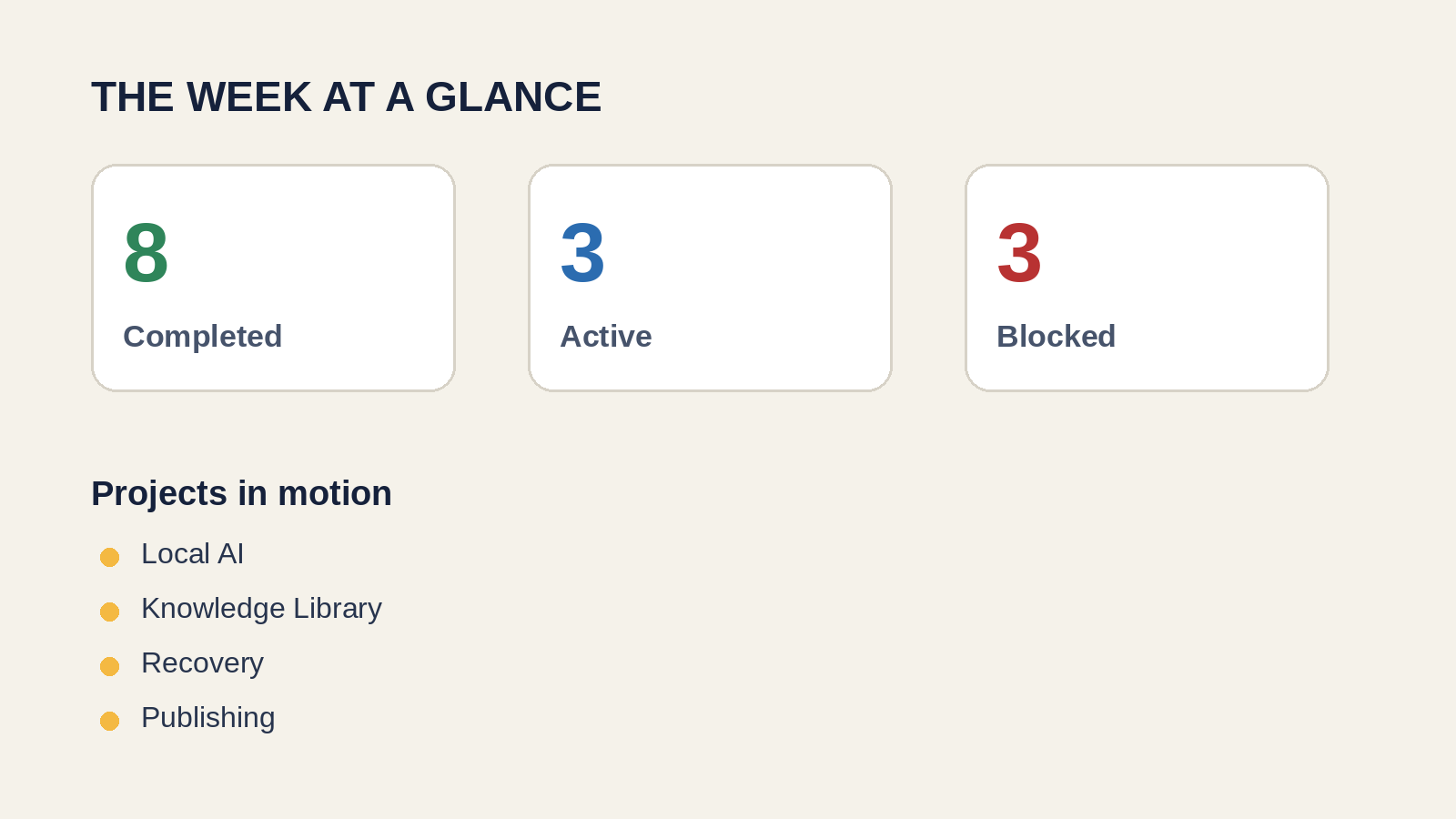
The next stretch should favor closing those gaps over expanding the experiment list. Eight completed milestones are worth celebrating; three active follow-through streams and three blocked work packages are worth describing honestly. Those are work-item counts, not a claim that every project is finished.
The week's best progress was not that everything worked. It was that more of the finished work could withstand a second look—and the parts that could not were finally labeled clearly.