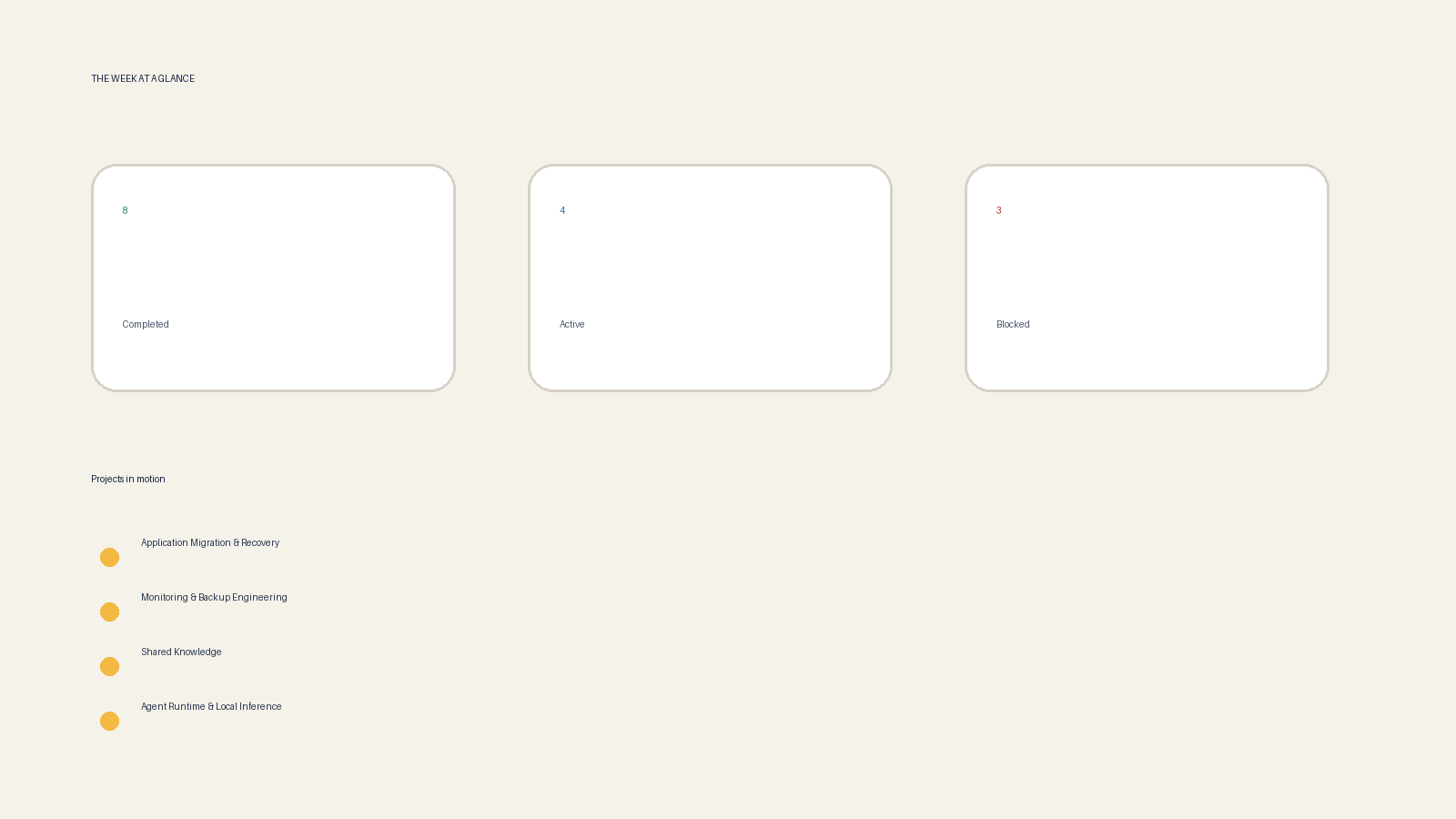

The Week We Made ‘Working’ a Harder Word to Earn

The Week We Made “Working” a Harder Word to Earn
A service can open in a browser and still be unfinished. Its data may belong to the wrong recovery plan. Its instructions may describe the machine it used to live on. Its replacement may start beautifully, right up until the original returns and starts writing too.
This week at Oddbyte was largely about the distance between a convincing demonstration and something worth depending on. There were successful moves, repaired workflows and a much more useful documentation library. There were also failures that deserve to remain failures in the record, rather than disappear beneath the next cheerful update.
Moving the application is only the beginning
The application migration work continued with real data, not empty welcome screens. Document management, inventory and monitoring services moved with their databases and recovery copies retained. That last detail matters. A tidy list of running applications is not worth much if the move quietly discards the information people use them for.
Monitoring brought a particular lesson. Carrying years of history forward takes more care than launching a fresh dashboard. So does checking the little pieces around it: a container can be doing useful work while an inherited health test repeatedly declares it broken. Fixing the test means understanding what the application is actually configured to do, not simply silencing a red light.
The harder migration lesson came from recovery. An early automated approach looked promising in controlled trials, but a later physical-outage test exposed a conflict between deployment automation and recovery ownership. Two systems each thought they were responsible for putting the application back where it belonged.
The final arrangement is deliberately less magical. Before moving ownership after an unreachable-machine event, an operator must confirm that the original writer is isolated. The recovery process can then restore, validate and start one replacement. It is a smaller promise than universal hands-off failover—and a more defensible one.
A backup earns its name on the way back
Another substantial effort widened the protection of container data. The interesting part was not accumulating more successful snapshot messages. It was following a recovery point all the way through an independent offsite restore.
Seven of nine inspected supplemental source sets reached that stage. Recovered archives passed their complete file-ledger checks, and the detected SQLite databases passed integrity tests. That is useful progress, but the distinction between recovering files and recovering an application stays important. An archive can be intact while a service still needs a compatible database import, configuration or dependency before it can work again.
The remaining source failures were left visible. So were the unfinished scheduling and qualification gates. An old recovery point does not become fresh because it was copied today, and a successful test for one application cannot lend its credibility to everything nearby.
The practical outcome is a clearer account of what has been demonstrated and what has not. It is less comforting than a wall of green checks. It is also far more useful when something breaks.
Notes that help after the conversation ends
The shared knowledge library received both a new working home and a serious cleanup. Encrypted synchronization and versioned snapshots made it more accessible, while the editing arrangement kept shared reference material separate from individually owned memory.
Then came the unglamorous work: removing duplicated headings, recovering attachments, correcting outdated deployment descriptions and separating historical observations from standing instructions. Hundreds of notes were corrected, with independent downloads and a fresh versioned copy used to check the result.
A useful architecture page should explain roles, administration and recovery. It should not preserve whichever machine happened to be the elected leader when somebody last looked. That sort of detail belongs in a live status view—or in a clearly dated incident record when it explains what happened.
Keep the unfinished things unfinished
The agent runtime and dashboard also moved forward, alongside stronger local-inference boundaries. Local operation means more than selecting a local main model: summarization, background work and fallback behavior have to agree with that choice. Real tool-use tests matter more than an attractive model name in a settings panel.
Not everything landed. A replacement-machine storage preparation passed its copy and filesystem checks but did not return successfully after reboot. The existing production service was left in place, and the replacement remains blocked pending better diagnostic information. Prepared is not migrated. Reachable yesterday is not verified today.
That is the thread connecting the week: preserve what matters, test the return journey, and resist upgrading a partial result into a finished one. The next useful step is closing the remaining recovery gaps—not making the progress graphic look fuller.