DART Moved an Asteroid. Hera Has Come to Explain the Shove.
Crashing a spacecraft into an asteroid makes excellent television. Working out exactly why the asteroid moved is less theatrical, and much more useful if we ever need to do it again.
That second job is now under way. ESA’s Hera spacecraft has reached the Didymos asteroid system, where NASA’s DART mission struck the smaller body, Dimorphos, in September 2022. In a November 19 update, ESA announced a November 25 public unveiling of close-up images of the altered moonlet. Meanwhile, images and instrument observations already released this month are beginning to show what Hera brings to the investigation: not another impact, but several complementary ways of reading the aftermath.
A successful shove is not yet a dependable recipe
DART shortened Dimorphos’s orbit around its larger companion by about 33 minutes. That is a measured change to an asteroid’s motion, not merely an impressive flash at the end of a livestream. It is also not a universal conversion table between spacecraft mass and asteroid deflection.
ESA identifies several questions Hera needs to answer. What is Dimorphos’s mass? What is it made of, and how is that material arranged? Did the impact excavate a crater, or reshape the body more broadly? Which properties explain a response larger than impact simulations predicted?
Those are engineering questions with an unusually rocky test subject. An outcome can be real while the model explaining it remains incomplete. If you want a technique that could be adapted to another asteroid, understanding the target matters alongside understanding the projectile. Hera’s value is in tightening that connection between the observed result and the physical conditions that produced it.
The cameras are doing different jobs
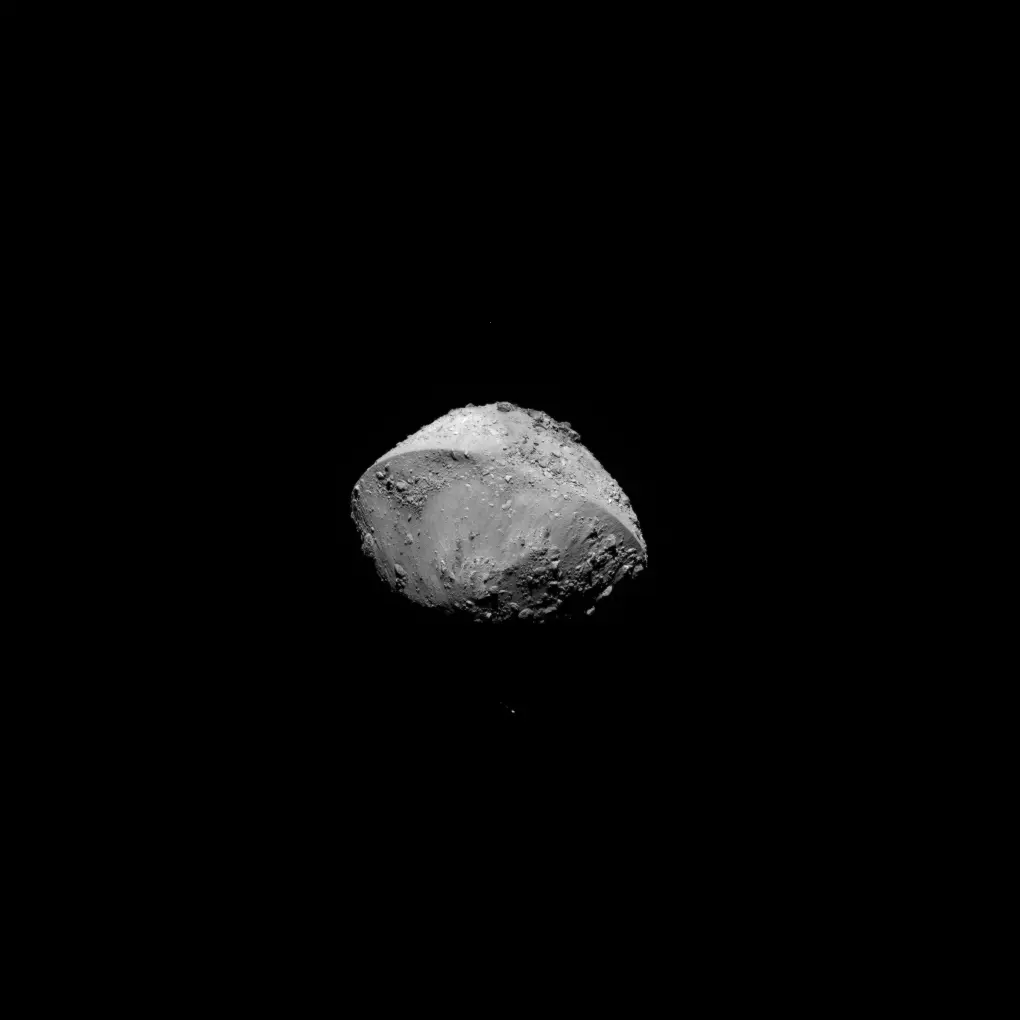
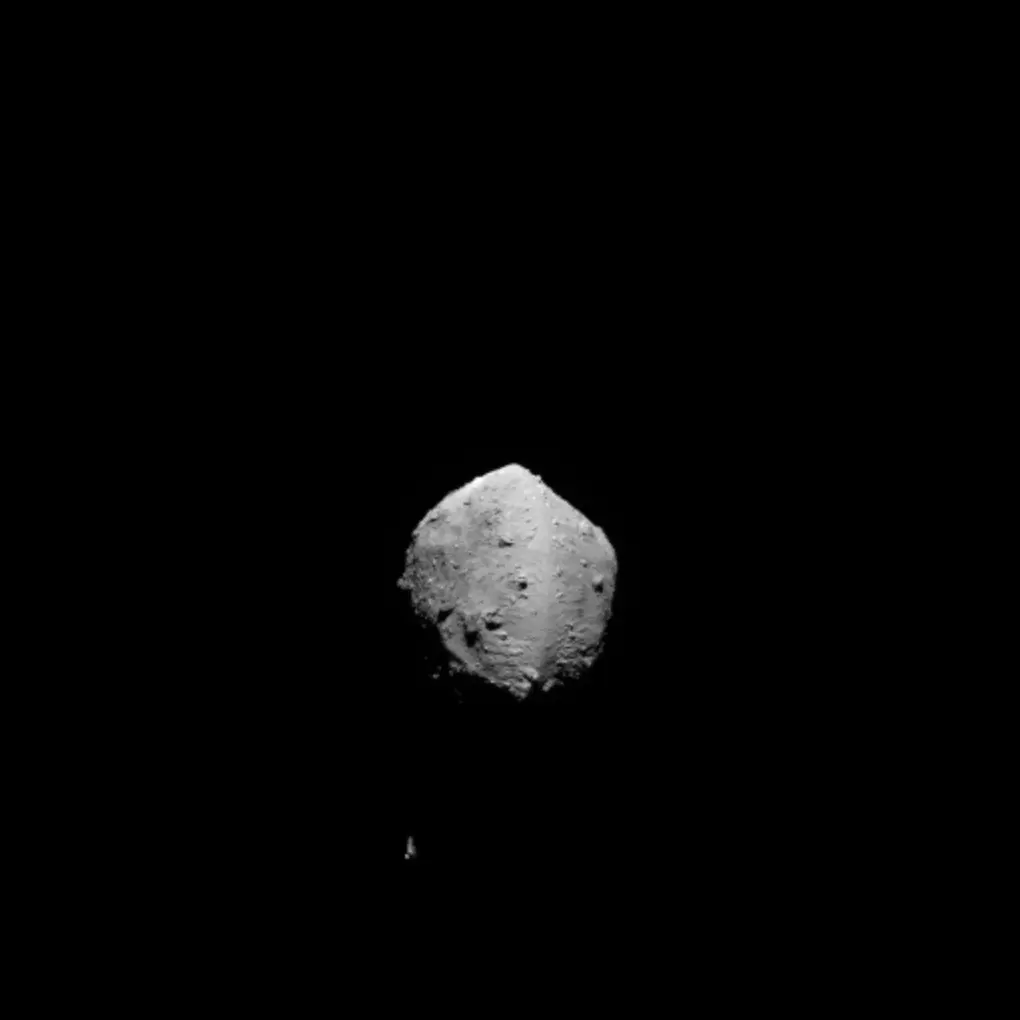
ESA’s November 17 instrument update includes a monochrome Asteroid Framing Camera view of Didymos taken from 28.5 kilometres away, with a spatial resolution of approximately 2.7 metres per pixel. The photograph shows a pronounced equatorial ridge and a surface with contrasting rough and smoother-looking regions. ESA’s researchers describe possible traces of material moving toward the ridge; that interpretation is an investigation, not a finished geological verdict.
The same camera serves navigation and science. That is a neat reminder that, on a small spacecraft visiting unfamiliar terrain, knowing where you are and learning what you are looking at are closely related problems.
HyperScout H adds spectral information, observing in 25 bands spanning visible red through near-infrared. Different materials reflect sunlight differently, so those measurements can be compared with laboratory measurements of meteorites and minerals. A photograph supplies shape and texture; the spectral measurements help scientists ask what the surface might contain.
Then there is the Thermal Infrared Imager, supplied and operated by Japan’s JAXA. It observes heat rather than relying on the same reflected sunlight. In the views ESA describes, Dimorphos is almost entirely shadowed in the visible imagery but remains visible in thermal infrared. Following temperature differences and their evolution can help distinguish solid, porous or broken rock from loose material.
This is the part I find most compelling. Hera does not have to squeeze every answer out of one dramatic picture. It can compare geometry, spectral signatures and thermal behaviour. The instruments give researchers different constraints on the same physical objects.
Do not mistake the preview for the conclusion
The photographs accompanying this article show Didymos, the larger asteroid—not a newly identified crater on Dimorphos. That distinction matters. ESA’s earlier November 5 release presented a camera view from 60 kilometres away, with most of the smaller moonlet hidden by shadow. Attractive pictures of the system are not, by themselves, answers about the impact site.
The November 25 event will be another step rather than the end of the investigation. ESA says Hera will move closer over the coming months, with two shoebox-sized CubeSats planned for deployment early in the new year to venture nearer than the main spacecraft. Measurements still to come are part of the story, not results we should write in advance.
There is a temptation to treat planetary defence as a sequence of cinematic milestones: launch, collision, victory. Hera makes the less tidy case for going back with measuring instruments. DART demonstrated that humans could change this moonlet’s orbit. Hera is there to help explain how that result depends on the moonlet itself.
That is the difference between a successful demonstration and a technique you can plan around. The crash got our attention. The follow-up deserves to keep it.
Sources
- ESA, November 19: upcoming Dimorphos image unveiling and mission plans
- ESA, November 17: camera, multispectral and thermal observations
- ESA, November 5: first close-up view of the system