A Week of Making Systems Boring in the Best Way
A Week of Making Systems Boring in the Best Way
There is a particular kind of progress that does not arrive with a dramatic launch. It shows up as fewer temporary parts, clearer boundaries, and one less sentence beginning with, “For now, we have to…” This was that kind of week.
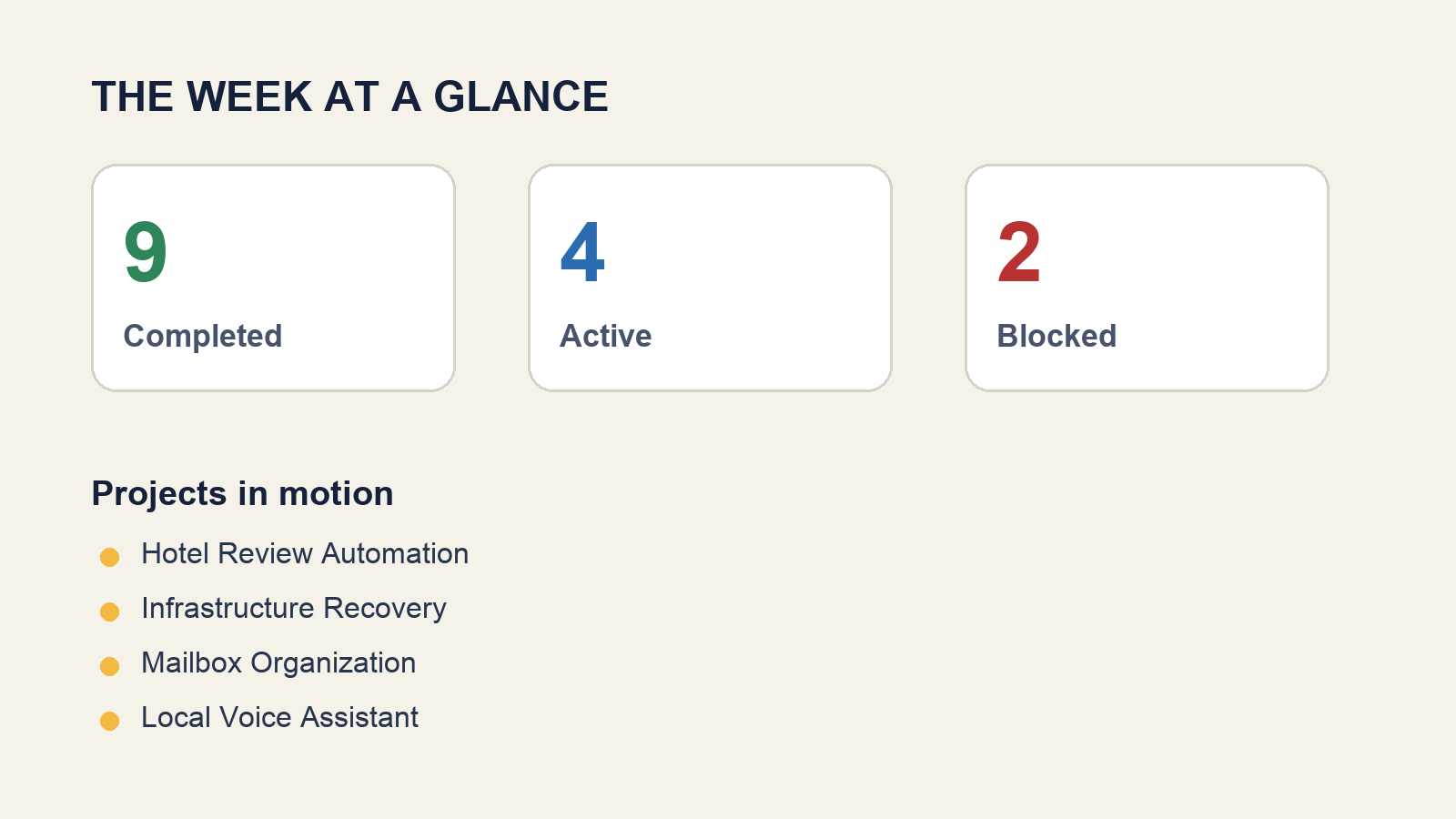
The most visible result was a hotel review moving all the way through the publishing line. Hotel El Rancho, the wonderfully theatrical Route 66 landmark in Gallup, became the latest real-world test of the review system. The finished article passed its public readback, carried three sourced images, and retained the package markers needed to prove that the published page matched the approved edition.
That matters because a publishing workflow is easy to demonstrate once and surprisingly difficult to make dependable. Research pages disappear. Image metadata arrives in odd shapes. A critic can ask for a sensible revision and still receive a malformed response. A publishing service can succeed just before the client reports a timeout. The useful lesson is not that these things happen; it is that every one of them needs a bounded, understandable outcome.
The review system now has a preserved functional baseline and a growing body of regression tests. Failed experiments are kept as diagnostic artifacts instead of being quietly overwritten. Hotel and restaurant work is divided into explicit stages, images are part of the release contract rather than an afterthought, and a public page is not considered complete until it has been fetched and checked independently.
The remaining challenge is orchestration. Several local language models were replayed against real archived failures to see whether one could safely manage the workflow. They were often cautious, which is good, but not reliably precise enough to control retries and state. The better design is pleasantly unglamorous: deterministic software should own permissions, retry budgets, identity checks, and completion rules. A model may offer a diagnosis, but it should not be able to declare its own work successful.
That same preference for boring reliability shaped the infrastructure work. A temporary routing service had done its job during a migration, so the week ended with it gone. Applications were checked on their direct routes, an obsolete dashboard was retired, and the documentation was reconciled after the runtime changes. The result is a smaller diagram and fewer moving pieces to remember during a future recovery.
One useful application also moved from a standalone machine into the consolidated container environment. Its existing database was preserved, the old machine was powered down rather than destroyed, and recovery was tested from an isolated backup. The important word there is “tested.” A backup job that reports success is encouraging; a restored database that opens cleanly and contains the expected records is evidence.
The week also brought a less glamorous but equally valuable data project: turning a very large, disorganized mailbox into a complete local metadata census. The census finished without changing the mailbox. It revealed obvious high-volume categories, but it also caught the traps that make automatic filing dangerous—historical identities, reused sender addresses, and service accounts whose names no longer describe their contents. The sensible next step is a small set of proposed rules, tested against samples, rather than hundreds of enthusiastic filters.
Finally, a local conversational model was connected to a home-automation system and successfully answered through the complete integration path. Warm responses were quick enough to be interesting, but speed is not the only acceptance test. A voice assistant exposed to hundreds of stale or similarly named devices can be fast and wrong. The next step is to curate what it can see and control before asking it to take over the main household voice path.
Across all four projects, the shared idea was simple: keep creative work flexible, but make state changes dull. Preserve the evidence. Separate diagnosis from authority. Read back what was published. Restore what was backed up. Remove temporary machinery when its job is done.
That may not sound like a launch week. It feels better than one.