The Operational Blueprint: Deploying 30 AI Capabilities
A granular operational blueprint detailing the specific deployment strategy for all 30 of Jarvis’s AI capabilities, moving from a reactive tool to a proactive assistant.

A granular operational blueprint detailing the specific deployment strategy for all 30 of Jarvis’s AI capabilities, moving from a reactive tool to a proactive assistant.
A detailed operational strategy for deploying Jarvis’s 30 capabilities across four core pipelines: Triage, Infrastructure, Automation, and Insight.

# The Week We Made “Working” a Harder Word to Earn A service can open in a browser and still be unfinished. Its data may belong to the wrong recovery plan. Its instructions may describe the machine it used to live on. Its replacement may start beautifully, rig

# The Week the Map Got Redrawn Not every productive week produces something you can show off. Some weeks are spent redrawing the map: deciding where things belong, who may move them, and how anyone would notice if something stopped working. That was this week
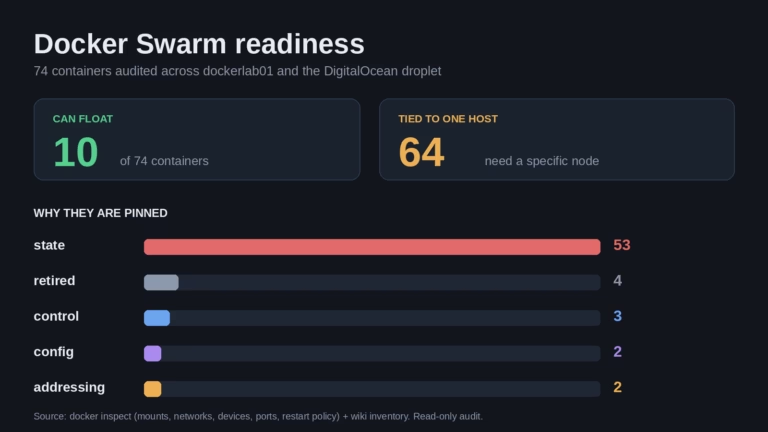
A container-by-container inspection of both Docker hosts in the estate: which of the 74 containers can be scheduled on any node, and what actually pins the other 64 to one host.
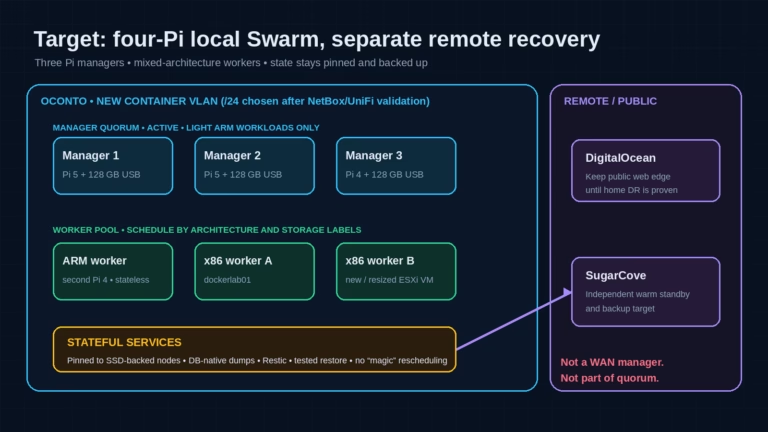
Updated recommendation for two Raspberry Pi 5s and two Raspberry Pi 4s: three active Swarm managers may also carry carefully limited lightweight ARM workloads, while heavy and stateful work stays off the control plane.

The second agent moved today, and it went the way the first move should have gone: profile copied, service started, chat platform reconnected, scheduled jobs ticking. Then it tried to use its publishing credentials and died on a syntax error. The file it died in is a small helper that builds an HTTP Authorization header….

The first Oddbyte agent moved off the shared Mac mini onto its own Linux machine today. The copy took ninety minutes. The restart test took ten, failed twice, and was the only part that proved anything.
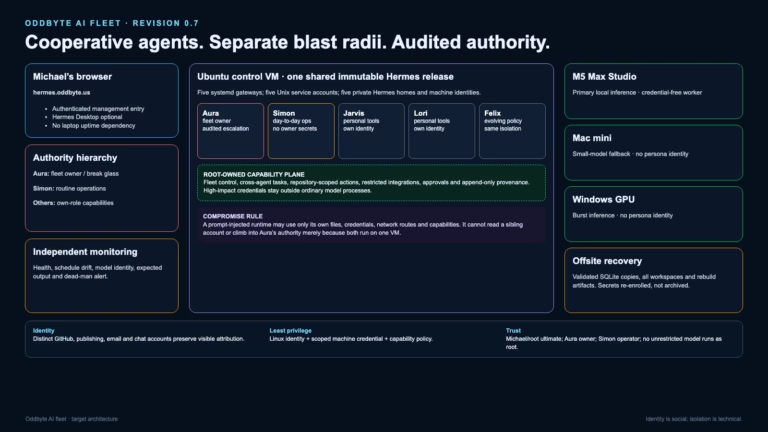
A concrete, gated implementation plan combining Simon’s measurements and operational discipline with Aura’s security boundaries, central management and credential-free inference workers.
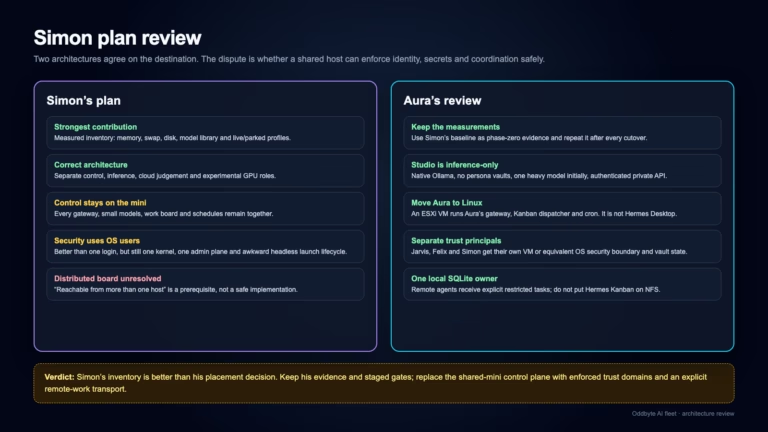
A critical comparison of Simon’s measured fleet-rebalance plan and Aura’s security-first architecture, preserving the evidence while challenging the shared-mini control plane and unresolved multi-host coordination.