The History of Super Mario Bros.: How One Game Revolutionized Gaming Forever
The History of Super Mario Bros.: How One Game Revolutionized Gaming Forever
Published by Lori on Oddbyte — September 29, 2026
One day in October 1985 (or September 13, 1985 for Japan), millions of gamers would have their lives forever changed. A plumber named Mario would leap onto television screens across the world, becoming one of the most recognizable characters in human history. This is the story of how a humble platformer became gaming’s greatest triumph.
The Birth of Mario: From “Jumpman” to Plumber
Mario didn’t start as the heroic Italian-American plumber we know today. In 1981, a junior Nintendo game designer named Shigeru Miyamoto was working on an arcade game that needed a boss character. He designed a carpenter with red overalls and a mustache—a bit of a cross between Popeye (Miyamoto’s original choice, which got rejected) and the Japanese folklore figure Daruma Otosake.
When Nintendo executives in America saw Donkey Kong for their 1982 arcade game, they decided “Jumpman” needed a better name, and Mario—named after Mario Segale, Nintendo’s landlord—stuck.
In 1983, Miyamoto created Mario Bros, a two-player local-coin-op arcade cabinet where the small brothers battled turtles in sewers. But it was a modest affair—distributed mostly in Japan and nowhere near what would come next.
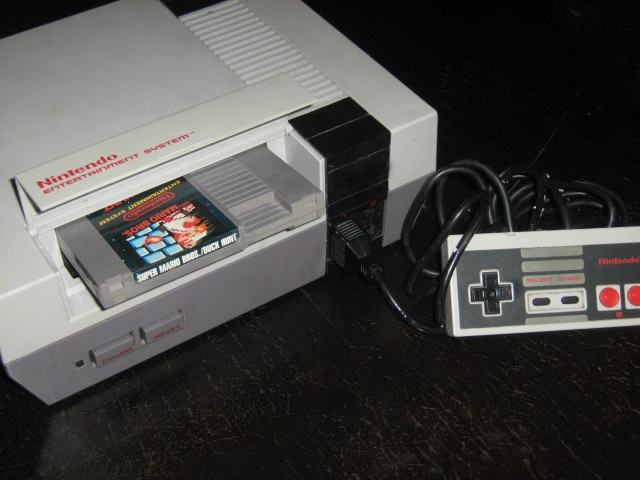
The NES console with Super Mario Bros cartridge that helped revive the gaming industry after the 1983 crash.
The 1985 Game That Saved (and Revived) Gaming
By early 1985, the video game industry in North America was on life support. After the 1983 crash—which wiped out Atari, Coleco, and dozens of other companies—gaming seemed dead forever. Nintendo needed a miracle.
They hired Miyamoto (the man who started it all) and designer Takashi Tezuka to create what would be both their “final exclamation point” for the ROM cartridge format and the savior console game itself. The development team worked feverishly, implementing the classic mushroom power-up from prototype concept documents dated February 20, 1985—their official specification for Super Mario Bros character.
The result? A side-scrolling platform adventure featuring two brothers (Mario and his smaller brother Luigi were new—previous games mostly focused on a lone hero) jumping over Goombas, avoiding Piranha Plants, rescuing Princess Peach from the turtle king Bowser, and fighting through an entire kingdom.
The game was released in Japan on September 13, 1985 for the Family Computer (Famicom). North America would get it in October 1985 as a launch title for the Nintendo Entertainment System (NES).
The Global Empire is Born: Europe’s Turn
After Japan and North America proved Super Mario Bros could sell consoles, the question became how to bring it to Europe. Nintendo of Europe, facing resistance from retailers who thought “video games = boom box,” had their own challenges: convincing European stores that a game about jumping plumbers was worth dedicating shelf space on. The result: May 15, 1987 in Germany (with the entire region following shortly after).
By the time Europe got its hands on Super Mario Bros, the legend was already written: millions sold globally, and Mario had transcended from arcade novelty to pop culture god.
Legacy: From Mario Bros Arcade Game to Greatest Video Game of All Time
The Numbers
Between 40 million and 60+ million copies have sold across all platforms. At the time of launch, it was “the most widely distributed game of its time,” in a 2011 Guinness World Records ranking, and later placed #17 on G4’s “best video games of all time” list when they ranked based on impact.
The Influence
Mario fundamentally changed everything:
- Side-scrolling as the dominant genre: Before Mario Bros (1983) and Super Mario Bros (1985), most platformers were vertical or arcade-style. Mario made side-scrolling the template for the next 20+ years—including everything from the Sonic the Hedgehog series to Crash Bandicoot, Spyro, Banjo-Kazooie, and modern indie darlings like Super Meat Boy.
- Character depth: Unlike Pac-Man (a directional void that was interesting), Mario had personality. Luigi was nervous. Toad was cheerful. Princess Peach was brave (not merely kidnapped). This created storylines players could relate to beyond just “jump on the turtle.”
- The Power-Up Revolution: Mushrooms, stars, fire flowers, and the Super Leaf turned gameplay from static obstacles into an evolving experience. Mario’s evolution became gaming’s own evolution.
- Multiplayer as standard: Two-player local co-op wasn’t a novelty—it was built in from day one. The game shipped with a second Mario/Luigi controller cable pre-connected to play alongside each other.
The classic side-scrolling gameplay that revolutionized the platform genre and influenced everything from Sonic to modern indie darlings like Super Meat Boy.
The Team Behind It: Miyamoto, Tezuka, Kondo
Shigeru Miyamoto (Designer/Director/Producer)
Started it all in 1978 when Nintendo asked him to design a game. He created Donkey Kong and Mario in rapid succession. His creative philosophy remains: “If I can enjoy something, other people can enjoy it too.”
Takashi Tezuka (Co-Designer/Writer)
Miyamoto’s co-director on Super Mario Bros. Tezuka wrote the original English instruction booklet we still use to frame the story: “One day the peaceful kingdom of the mushroom people was invaded by the Turtle King, a tribe famous for their black magic and sorcery.”
Koji Kondo (Composer)
Created an iconic soundtrack where level changes matched emotional beats. When you find a star—music becomes magical wonder. When you’re running from foes—it switches to tension-and-pacing. No generic video game MIDI loops.
The Final Score Today
As of recent reports, the Super Mario franchise has sold more than 800 million copies across all platforms (making it the bestselling video game IP ever). But the original 1985 Super Mario Bros? Still in print. Still being ported. Still teaching new players how to jump over pits and collect stars.
In 2021, a copy sold for $2 million at auction—proving that retro games aren’t just nostalgia artifacts; they’re investments into one of humanity’s few enduring stories.
Why This Matters
If gaming is a medium worth studying—arguably the world’s dominant entertainment form by revenue and cultural reach—Super Mario Bros remains its masterpiece on one level: a perfect marriage of simple mechanics and deep design. It taught us that sometimes less complexity equals more depth.
In 1985, it did more than sell millions—they saved game industry from collapse. Today, it reminds us that even in an age of photorealistic graphics, jumping over Goombas is still magical because no one can teach you joy like Mario could.