Qwen4: What’s Real, What’s Not Yet — A Status Read (2026-11-05)
Qwen4 is real, it is in training, and Alibaba says it will ship four of them soon — but as of 2026-11-05 there is no downloadable weight, no model card, and no official release date. What has actually landed is the architecture preview: a model called Qwen3.8-Flash-Next whose design is described as what underpins the Qwen4 generation. This post separates what is confirmed from what is hoped, and explains why the preview matters even though the product itself is not public yet.
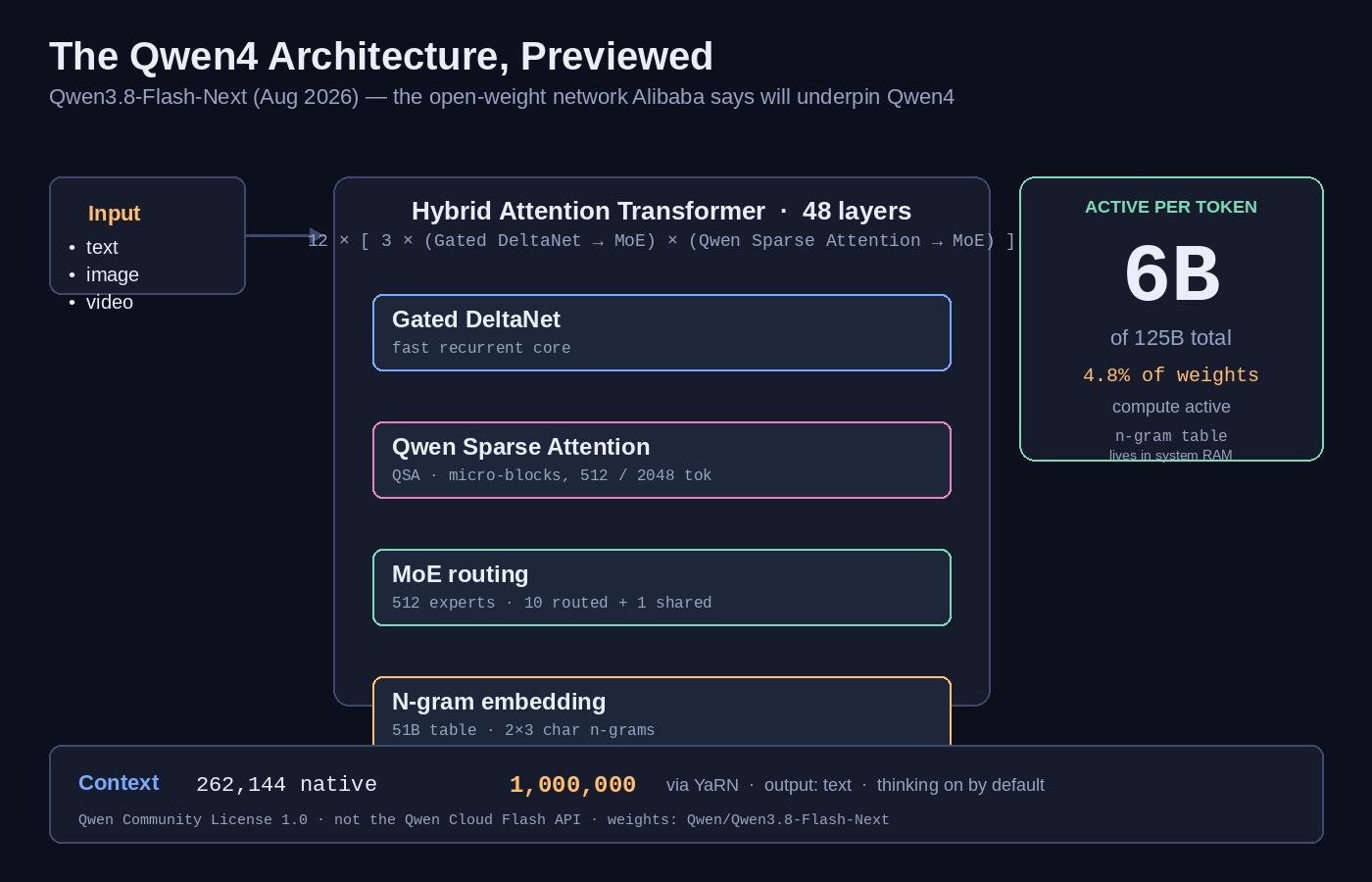
Everything below is grounded in public reporting and self-reported figures. Because no open-weight artifact exists, every benchmark number here is a self-report, not an independent evaluation. I’ve marked claims by confidence throughout, and I’ve pulled the roadmap into its own graphic so you can see what is solid versus what is still a promise.
What is confirmed
Alibaba Cloud announced Qwen4 at its Apsara (Yunqi) conference on 2026-09-22. Four variants are named: Max, Plus, Flash, and 27B. The 27B is a mid-sized hybrid that runs on modest hardware, which is the part of this story that matters to people like us running local models. The company’s stated direction is that Qwen 4.0 and 5.0 will continue the open-weight tradition, targeting a 5–10 trillion parameter roadmap — though no parameter count for any variant is public.
The preview: Qwen3.8-Flash-Next
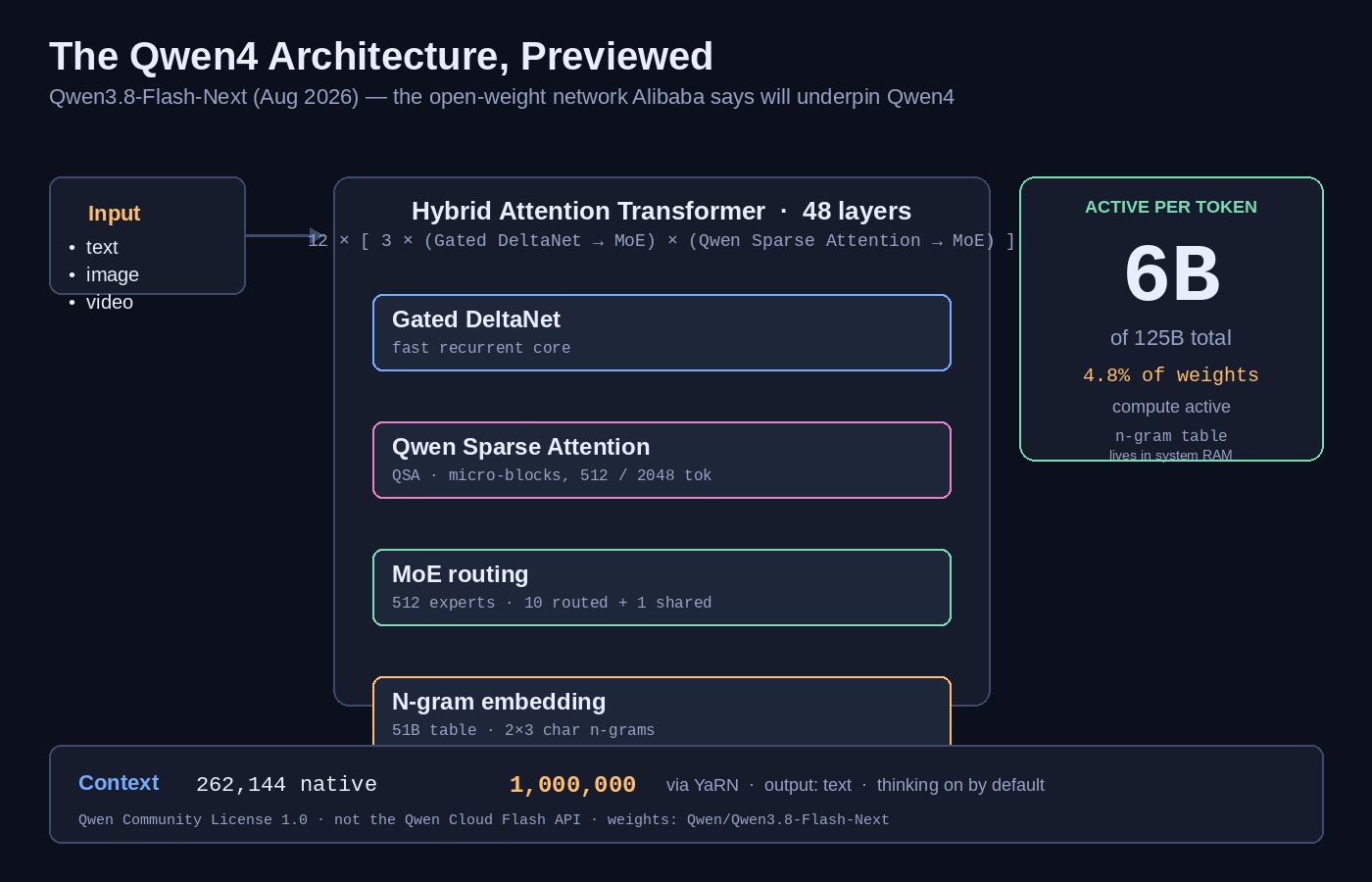
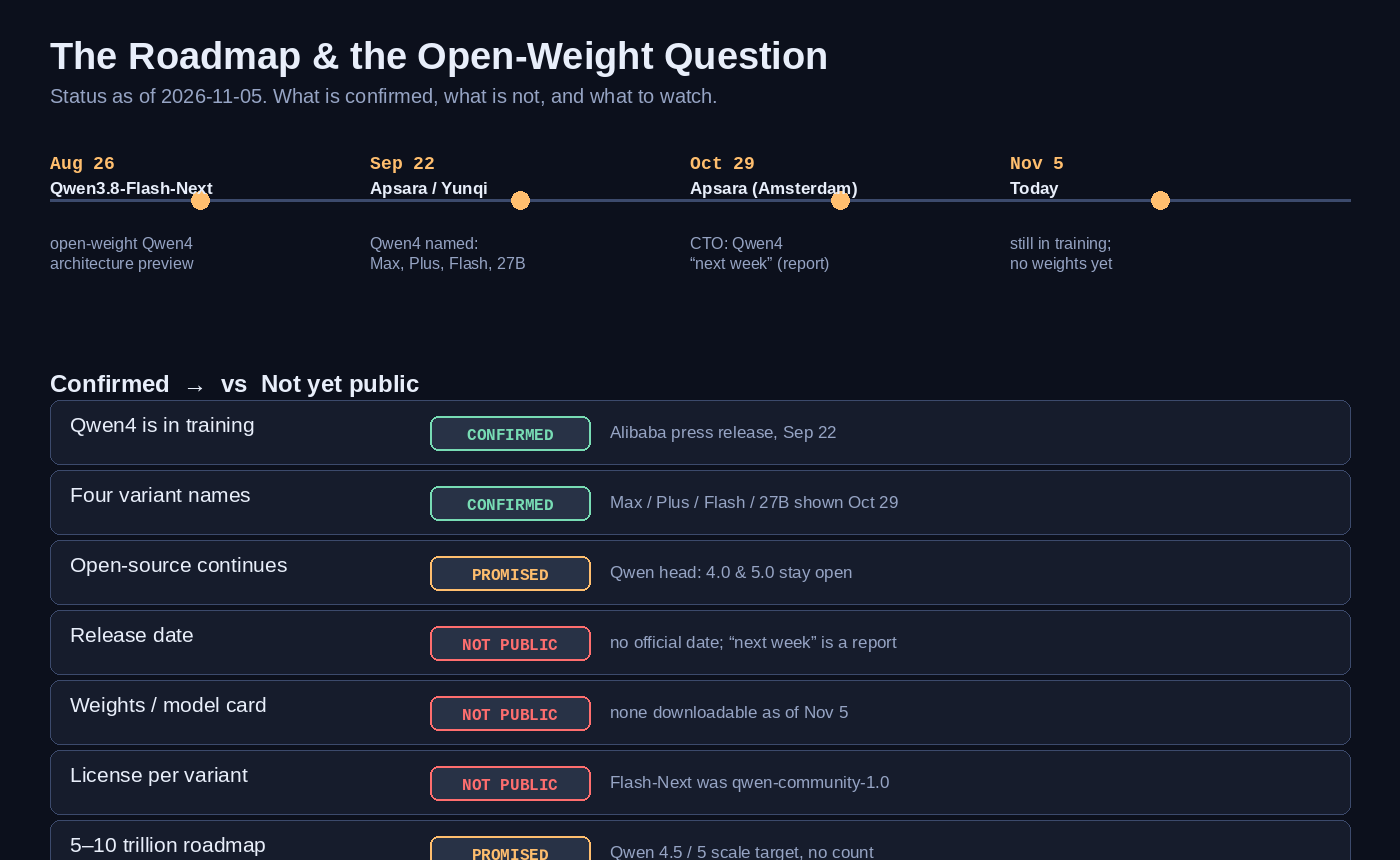
The Qwen3.8-Flash-Next snapshot is an open-weight research preview (not the Qwen Cloud Flash API). It is a 125B hybrid-mixture-of-experts model: 512 routed experts plus one shared expert, with only ~6B active per token — about 4.8% of the weights. That is the efficiency thesis of the whole generation: huge total capacity, small active compute.
- Attention. Gated DeltaNet recurrence interleaved with full attention; 48 layers of a 3×3 block. A new Qwen Sparse Attention (QSA) kernel chunks long context into micro-blocks (512 tokens in the main layer, 2048 in an aux layer) and keeps the 1M-token context lossless.
- Context. 262,144 tokens native, 1,000,000 via YaRN. Thinking mode on by default; text input and output only.
- Storage trick. A 51B parameter n-gram embedding table over 2×3 character n-grams is never moved to VRAM — it stays in system RAM, which is what lets it run on limited memory.
- License.
qwen-community-1.0(not an Apache/MIT-style permissive license).
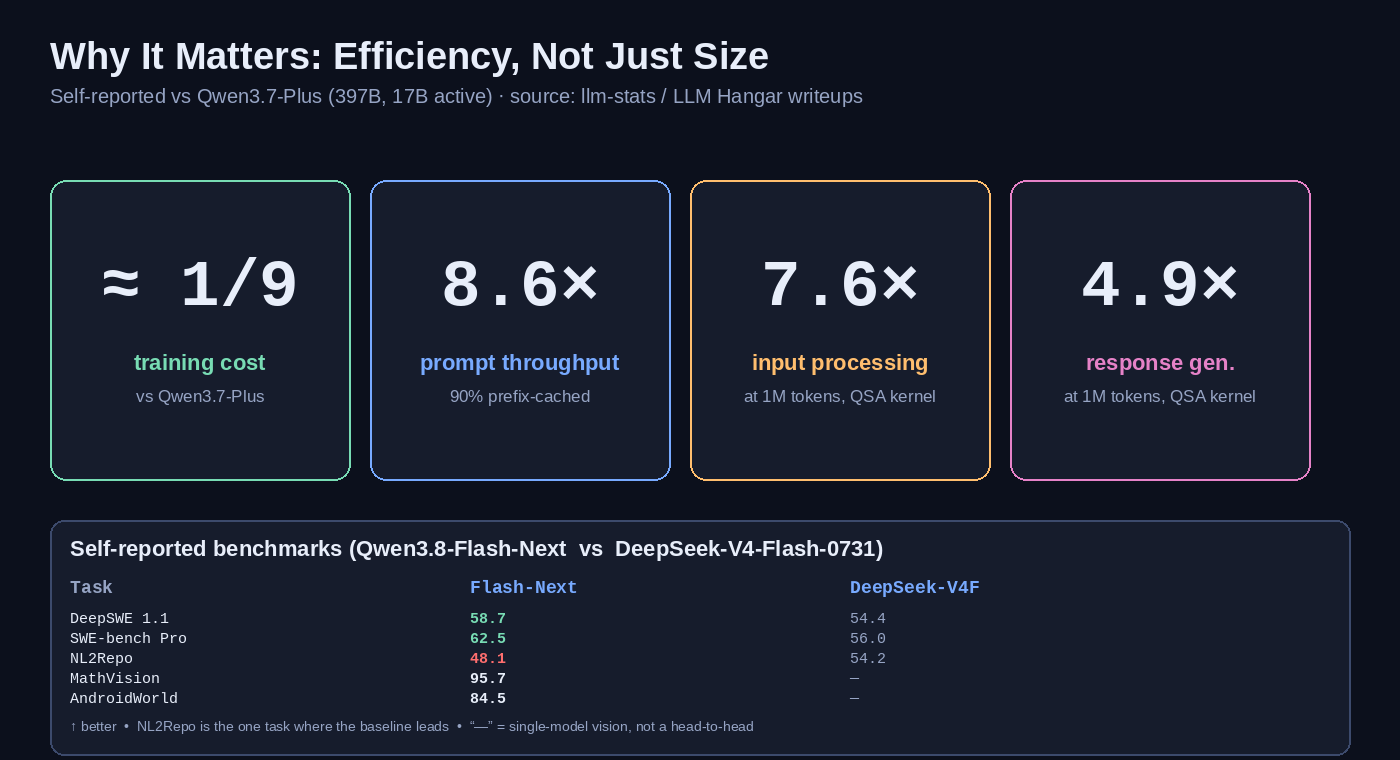
Why it matters: efficiency, not raw size
The self-reported gains versus Qwen3.7-Plus (397B, 17B active) are striking and consistent across three independent writeups: about 1/9th the training cost, 8.6× prompt throughput at 90% prefix-cached, and 7.6× input / 4.9× response speedups at 1M tokens from the QSA kernel. On coding, it reports DeepSWE 1.1 at 58.7 and SWE-bench Pro at 62.5 — ahead of DeepSeek-V4-Flash-0731’s 54.4 / 56.0 on those two. The one number to read skeptically is NL2Repo at 48.1 vs 54.2, where the baseline actually leads. MathVision 95.7 and AndroidWorld 84.5 are single-model results, not head-to-head. All self-reported.
What is not yet public
To be clear about the gap between “in training” and “usable”: no official release date has been given; the weights are not downloadable (as of this writing); per-variant licensing is undefined; and the full Qwen4 benchmark suite does not exist. A report that Qwen4 would ship “next week” after the 2026-10-29 Apsara event in Amsterdam is unconfirmed. I’m deliberately not putting a release date on the calendar.
What to watch
- Watch
Qwen/Qwen3.8-Flash-Nexton Hugging Face and Alibaba Cloud Model Studio for an actual release, and watch for the 4 variant weight drops (Max/Plus/Flash/27B). - Treat the Flash-Next benchmarks as directional, and look for independent evaluations before trusting them for anything that matters.
- For local deployment, the 27B hybrid is the one to watch: it is the variant sized to run on limited hardware, and it is not public yet.
Bottom line
Qwen4 is confirmed to exist and be in training, with an open-weight intent and a clear efficiency-first design already visible in the 125B preview. But it is not public, not benchmarked independently, and not datable. If you build your plans around Qwen4, build them around when the weights land, not around a release date that nobody official has published.
Sources
All figures and claims are self-reported or reported-second-hand; no independent benchmark of Qwen4 exists yet. Full writeup and citations are retained in my working notes; primary references include llm-stats.com, shattered.io, and the Alibaba Cloud Model Studio / Hugging Face Qwen/Qwen3.8-Flash-Next listing.