Google Bets on Specialization With Two New AI Chips at Once
Google has a habit of building its own hardware before anyone else needs it. A decade ago it was doing that for voice recognition and language translation; today it is doing it for the machines that will run the world’s AI agents. On Monday, the company added two systems to its eighth generation of Tensor Processing Units, the in-house accelerators that increasingly do the heavy lifting behind its Gemini models. The new pieces, TPU 8tx and TPU 8i Max, are not new silicon so much as new configurations of silicon Google already makes, and that distinction is the heart of the announcement.
What is striking is the pace. Google introduced TPU 8t and TPU 8i at Cloud Next back in April, one for training and one for low-latency reasoning. Now it has added two more, putting four eighth-generation systems into a single year for the first time in the TPU’s history. That is a dramatic shift for a chip line that used to release a new processor roughly every two years. As Amin Vahdat, who runs Google’s chip business, put it, the company can build “specialized supercomputers in a matter of months rather than years.”
Building the computer around the chip
The reason Google can move that fast is a design bet made a long time ago. Designing a new chip is a multi-year affair, constrained by the physics of laying out billions of transistors and the long, unforgiving manufacturing process that follows. A system, by contrast, is about how you assemble the compute, networking and storage around the chip, and that is the part you can rework in months. From the very first TPU, Google treated the chips as building blocks inside what it calls an AI Hypercomputer, so engineers can repackage them, add high-speed memory, rewire the optical networking, and layer on security without starting a new die.
That modularity is exactly what the two new systems are. TPU 8tx is built on the same silicon as the 8t training chip, paired with AMD’s fifth-generation EPYC processors as hosts. Its job is confidential computing: data and model weights stay encrypted and isolated even while a chip is actively working on them. Normally a computer has to unlock data in memory to process it; the 8tx keeps it sealed at the hardware layer, which is the kind of guarantee that regulated enterprises and government customers ask for when they want to fine-tune models on private data without moving that data between clusters. By adopting the same low-latency Boardfly network Google built for real-time reasoning, the system claims up to twice the latency advantage of the 8t with almost no performance penalty.
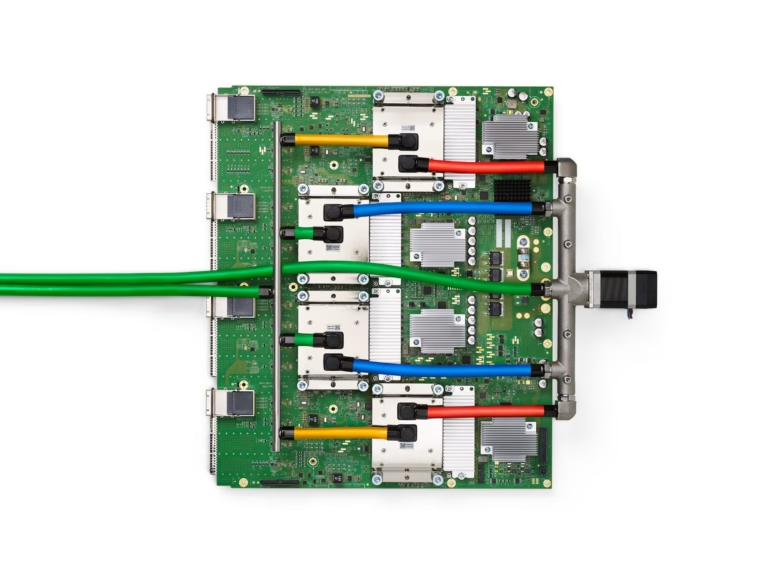
TPU 8i Max tackles a different wall: memory. When dozens of agents work across an entire codebase or several hours of video at once, the bottleneck stops being raw compute and becomes how fast the chip can feed itself data. So Google put two 8i inference chips onto a single package, doubling the compute, on-chip SRAM and high-bandwidth memory bandwidth, and doubling the silicon per rack footprint in the process. The result is more compute per square foot and per watt, aimed squarely at the “memory wall” that long-context and agentic workloads keep running into.
A menu for the agentic lifecycle
Seen together, the four systems read as a deliberate menu. TPU 8t for large-scale training, TPU 8i for low-latency reasoning, TPU 8tx for confidential computing, and TPU 8i Max for massive context windows and maximum density per rack. Google frames that as “a purpose-built accelerator for every stage of the agentic lifecycle.” The company is now describing TPUs as “a rapidly growing business with nearly 100 customers,” a group that stretches across frontier AI labs, trading firms, retailers and universities, and one that increasingly wants to deploy the chips directly inside its own data centers rather than only through Google Cloud.
That last point is quietly significant. It is the newest commercial line for the TPU business, and it means Google is trying to become not just a supplier of chips but a supplier of the whole stack around them. Part of that stack is software, and a lot of it is now open source. Last month Google open-sourced TorchTPU, which lets PyTorch code and Hugging Face models run natively on TPUs with no code rewrites, and it pairs with backends for popular inference engines like vLLM and SGLang. A new TPU agent suite, in preview, plugs into coding tools such as Claude Code, Cursor and Google Antigravity to automate onboarding and autotune kernels in plain language. And a project called TPU Sync, also open-sourced, is a model-state layer that treats chip memory, host memory, shared storage and the data center network as one hierarchy, moving large caches off the chip in milliseconds and cutting time-to-first-token by more than 90 percent, a figure Google did not give a baseline for.
Why it matters
The broader story is specialization, and it is not Google’s. The whole industry is drifting toward purpose-built silicon, trying to escape the gravitational pull of Nvidia’s general-purpose GPUs. Amazon is doing it with its Trainium line, Microsoft with its Maia family, and OpenAI with its own chip built on Broadcom silicon. Nvidia, which long sold its GPUs as the answer to every AI task, is now shipping its own CPUs and inference chips too. So Google’s move is less a lone bet than a signal that the next decade of AI compute will be decided less by who has the single best chip and more by who can assemble the most flexible system around a chip.
There is a catch, and Google did not hide it. The company did not publish a price, a shipping date, or a list of regions for either new system, and both are expected to arrive next year. TPUs are also constrained by the same shortages of memory and manufacturing capacity that squeeze everyone in this space; every TPU Google has on hand, it has said, is already contracted to a customer. And while TPUs are often cheaper per workload than Nvidia’s GPUs, Google’s margins on them are thinner. What Google has delivered on Monday is a wider menu and a faster cadence, not a lower bill. For the nearly 100 organizations already using its chips, and for the many more that will watch closely, that is the difference between a platform that grows one chip at a time and one that keeps growing the whole machine around it.