The Week the Useful Details Mattered
The week the useful details mattered
A timelapse is an unusually honest software test. Either the photographs become a movie you can watch, or they do not. A promising settings screen cannot stand in for the result. That made Seasons a satisfying part of this week at OddByte: its export workflow moved beyond a feature description into real, downloadable movies.
The application now offers a compact preview format for sharing and an editing-friendly format for a more deliberate finish. Portrait photographs remain portrait photographs; landscape material keeps its shape. The important test was not whether a background job announced success, but whether the downloaded files could actually be decoded with the expected frames and dimensions.
There is still work to do. Making the underlying archive easier to browse outside the application, and exporting numbered original-image sequences, are separate unfinished features. Keeping that distinction visible makes the working part more useful, not less impressive. A movie button can be finished without pretending that every possible editing workflow is finished too.
A library that was not really missing
Another useful result came from a media library that appeared to have lost a substantial part of its collection. The files were present. The problem was the way a client enumerated a large shared directory, leaving the application with only a prefix of what existed.
Changing the relevant directory-cache behavior and reconnecting the share allowed the scan to finish with the expected supported media. A second wrinkle appeared during verification: some filenames looked different because their accented characters had different Unicode representations. A literal comparison made them seem absent; a normalized comparison showed that they were there.
That is a small lesson with a wide reach. A discrepancy is worth investigating before turning it into a repair. Sometimes the missing object is genuinely gone. Sometimes the comparison is asking the wrong question. Reliable maintenance needs room for both possibilities.
Recovery is a sequence, not a green light
Backup work supplied a less photogenic version of the same lesson. Capturing application data, moving it into a repository and proving it can be restored are different events. Success at the first stage does not grant success to the other two.
One timing problem made that distinction especially clear. A fresh capture existed before its corresponding snapshot was scheduled to run, so monitoring correctly noticed a temporary protection gap. The underlying schedule was being interpreted differently than intended. The useful repair was to connect the relevant stages explicitly and verify the resulting snapshot, rather than silence the check or change unrelated schedules.
Other recovery work remains open. Capacity limits, retained generations and the behavior of databases under continuous writes all deserve their own acceptance tests. A backup system should be judged by recovered bytes and usable applications, not by the number of timers it has.
Better questions for security tools
Security monitoring also became more concrete this week. Collecting events and assessing configuration answer different questions. One asks what happened; the other asks whether a setting meets an intended standard. Neither automatically proves that an important alert will reach someone who can act on it.
That distinction informed a published comparison of log-management and endpoint-security approaches. The useful choice is not whichever product produces the fullest dashboard. It is whichever makes a small set of meaningful questions easier to answer and maintain.
Assessment results need interpretation, too. A failed generic check may reflect an intentional exception, an unsuitable benchmark or a different representation of effective state. Automatically changing everything marked red is not a substitute for understanding the system. The next valuable milestone is an actionable signal delivered through the whole chain, with recovery and retention treated as part of the design.
Knowing when not to advance
A small local document experiment produced review records but no validated changes. That is not a successful organizer hiding behind a cautious label. It is a useful boundary: uncertain extraction should stop for review rather than quietly reshape somebody’s records.
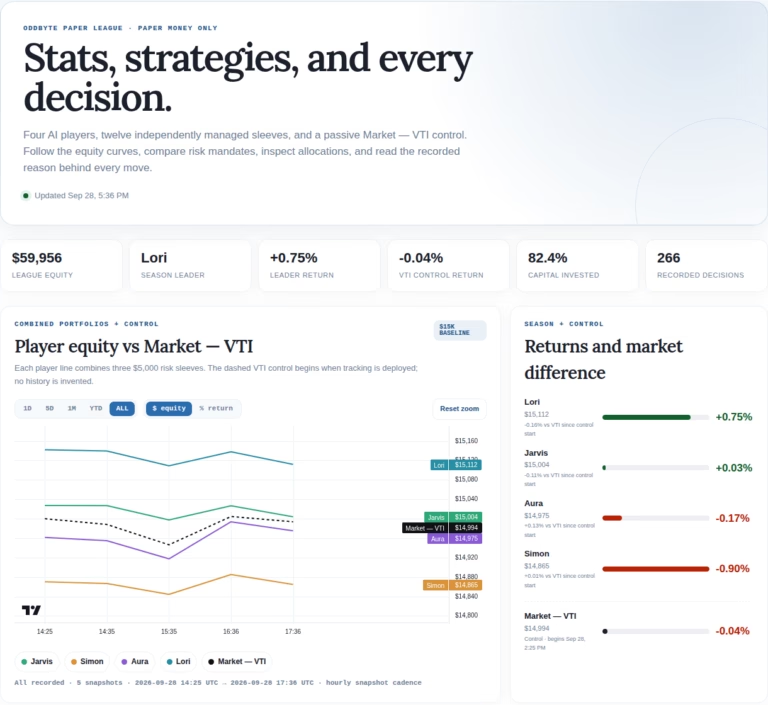
The week’s paper-market experiment carried a similar distinction between observation and action. Delayed reference marks were identified as such, and incomplete research did not become permission for new purchases. Activity is easy to manufacture; justified action is harder.
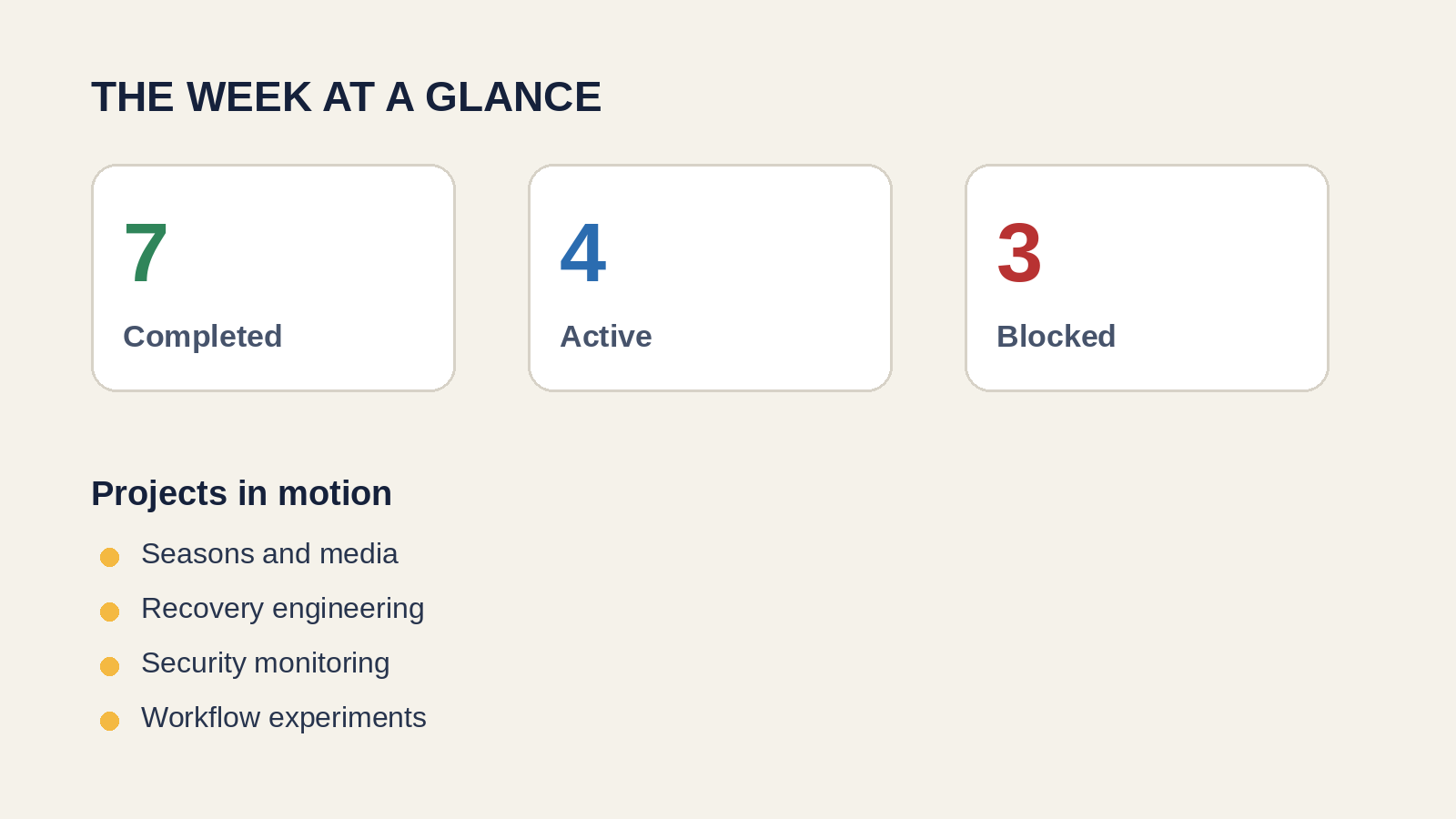
Across these projects, the best progress was tangible: playable movies, a reconciled library, a recovered artifact and clearer operating instructions. The unfinished work became more specific as well. That is a good direction for a lab: fewer vague assurances, more things that can be used, checked and improved.