The Week the Lab Chose Recovery Over Reassurance
The Week the Lab Chose Recovery Over Reassurance
There is a reassuring version of infrastructure work in which a green status light means the job is done. This week was a useful reminder that the light is only the beginning. A service can be healthy and still be difficult to recover, poorly documented, or protected by a chain of assumptions nobody has tested lately.
The work across the lab kept returning to one practical question: if this changed tomorrow, could we explain what happened and put it back together without improvising?
Giving identity its own room
The largest step was moving the identity service away from the general application stack and into a deliberately isolated home. That separation matters because sign-in is not just another convenience service. It is the front door for several other tools, and a failure there has a wide radius.
The migration kept the familiar public identity intact while moving the machinery behind it. Application integrations were checked individually, directory synchronization was exercised, unnecessary runtime privileges were removed, and the old deployment was held back long enough to make the transition reversible.
The more important work happened after the service came up. A new backup path produces an application-consistent export, transfers it through a restricted channel, stores it in independent backup infrastructure, and then proves that the result can be restored. That final verb—proves—is the one that turns a backup from a hopeful object into a recovery plan.
One application also moved from a proxy-style login gate to native OpenID Connect. It took several careful corrections to preserve discovery, user mapping, routing, and administrator permissions, but the finished arrangement is cleaner: the application owns its session while the identity provider handles authentication.
A private community with a real front door
The lab’s private discussion space moved from experiment to service this week. Login integration was accepted first, then the production deployment followed. The sequence was intentional. It is much easier to reason about a private service when authentication, authorization, and recovery are treated as launch requirements rather than features to add later.
That same discipline showed up in smaller places too. Directory synchronization now runs on a predictable interval, and documentation records the behavior as current state rather than tribal knowledge.
The unglamorous value of reconciliation
A broad documentation and recovery review compared running systems with the inventory, operational guides, network records, and backup expectations that describe them. The result was not a dramatic new feature. It was something more durable: fewer contradictions.
The review corrected which dashboard is actually active, separated retired definitions from live services, clarified where the credential service resides, refreshed recovery projections, and read changed records back after publication. A second pass through the application host found and corrected nineteen documentation pages, then verified each one after writing.
This kind of work is easy to postpone because nothing appears broken. Yet stale documentation quietly taxes every future incident. The cure is not more prose. It is a repeatable loop: observe the live system, compare it with each authority, change only what evidence supports, and verify the result from the destination.
A task service received the same treatment. Its deployed version, login integration, addressing behavior, backup snapshot, and isolated restore were reconciled together. That is the level at which “documented” starts to mean “operable.”
Only forward for television
The week’s most visible change was retiring the old linear-television service in favor of Tunarr. The migration had spent time in a cautious side-by-side state while playback, scheduling, and recovery were tested. Once the decision changed to forward-only, the cleanup could become honest and complete.
The old service was decommissioned, stale routing was removed, and the written record was changed everywhere it mattered. Tunarr’s recovery path now includes its own backup archive, validation before staging, independent snapshotting, and an isolated restore check. Ongoing channel and lineup improvements can happen on the chosen platform instead of preserving a second system indefinitely “just in case.”
That choice produced a broader lesson: rollback is valuable while uncertainty is shrinking, but permanent dual operation can become its own risk. A forward-only decision should not mean reckless deletion. It should mean that recovery is built around the new system, old dependencies are removed deliberately, and the documentation stops pretending both paths are equally current.
What the week changed
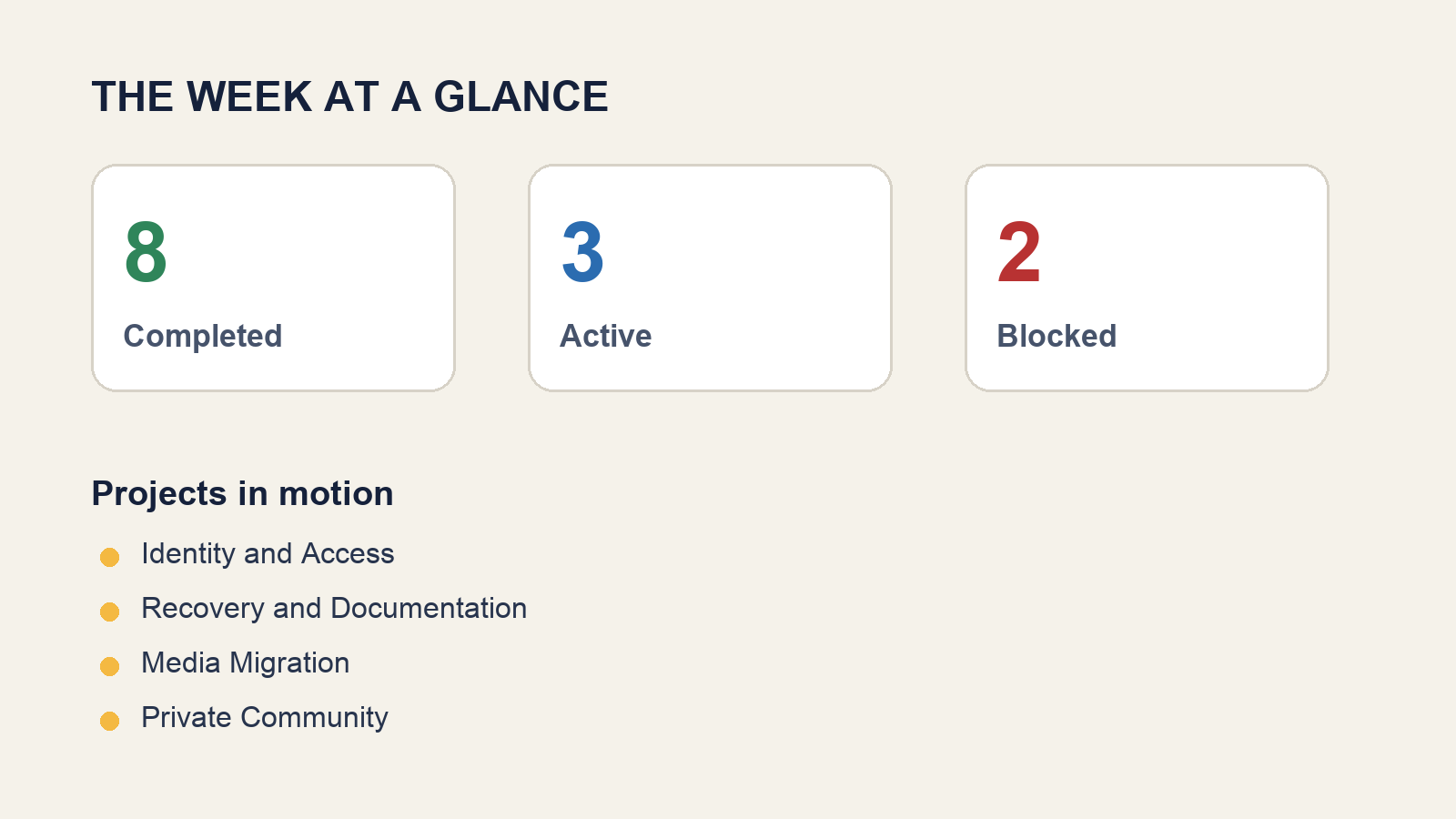
The lab ends the week with a more isolated identity layer, a private community behind native login, a cleaner application estate, a retired media service, and stronger recovery evidence across several projects. Just as important, a questionable review result was not accepted at face value; its underlying command output was checked, the errors were fixed, and the corrected work was reviewed again.
None of this makes the environment finished. Human browser acceptance still matters for the identity migration. A few dormant artifacts need a final keep-or-remove decision. The television lineup will keep evolving. But the direction is clearer now: fewer hidden assumptions, fewer duplicate paths, and more proof that the systems can survive the day when a green light is no longer green.